





Steps 1 to 4
Part one: Strategy
One journey, eleven steps
Every build in these playbooks reads what was decided before it started: what's true, why a buyer should choose you, who chooses, and where you stand today. Get those right once and the builds agree with each other. Leave them out, and each build invents its own version: the website describes one firm, the pitch another, the ads a third.
So the playbooks follow one journey, in eleven steps. Each step answers one question and reads only the steps before it. RocMode's Brand Journey follows the same steps, with the same names, and so does the book.
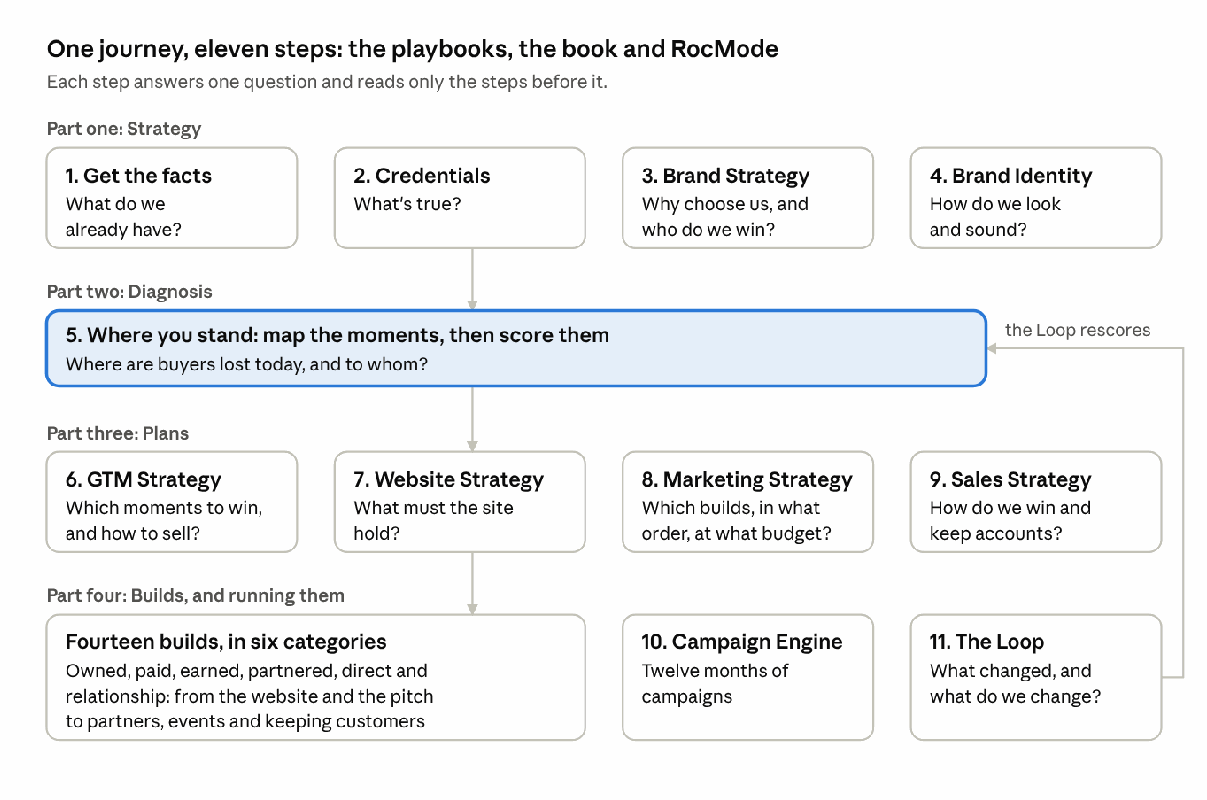
| Part | Steps | What it settles |
|---|---|---|
| One: Strategy | 1. Get the facts · 2. Credentials · 3. Brand Strategy · 4. Brand Identity | What's true, why choose you, who you win, how you look and sound |
| Two: Diagnosis | 5. Where you stand: map the moments, then score them | Every moment that matters, and where buyers are lost today, and to whom |
| Three: Plans | 6. GTM Strategy · 7. Website Strategy · 8. Marketing Strategy · 9. Sales Strategy | Which moments to win, what the site holds, which builds and budget, how accounts are won and kept |
| Four: Builds, and running them | The fourteen build playbooks, in six categories · 10. Campaign Engine · 11. The Loop | The work itself, twelve months of campaigns, and what changes when the numbers move |
This part covers steps one to four. It maps onto the Selectability Model: the facts are the evidence; Credentials hold the offer and the one truth; Brand Strategy holds the reason; Brand Identity is what makes a brand familiar, and familiar feels safe.
The worked example. Every playbook uses one firm: Kestrel Advisory, an invented operations consultancy. Kestrel, its buyers' questions and every figure attached to them are invented. A real firm fills these in from its own records.
1. Get the facts: what do we already have?
Everything after this step can only use what's gathered here, so gather it once, from everywhere, and keep the source of every fact. In RocMode, this is ingestion: the firm's website, documents, profiles and client records are read into one store, and every fact keeps a link to where it came from.
Kestrel's sources (invented):
| Source | What it holds |
|---|---|
| The website and the old blog | How Kestrel describes itself today, which turns out to be "we help organisations transform" |
| Standard terms and the contract template | The fixed price, the six weeks, the way out |
| The client list and sign-off letters | Who Kestrel works for, and the figures clients have agreed to share |
| Proposals, tenders and briefs | What buyers asked for, in their words, and what they judged on |
| Sales call notes and lost-deal interviews | The questions buyers ask, and why deals were lost |
| Client debriefs | What happened after the review, and what clients needed then |
| People's profiles | Who will be on site, and their plant experience |
Two rules make this step pay off later. Keep the buyer's words, not a summary of them: they become the moments in step five. And gather the evidence for losses as carefully as wins: the lost-deal interviews are where the switching moments hide.
2. Credentials: what's true?
Credentials come first because everything else repeats them. In RocMode, credentials are built by reading what the firm has already published and stored (its website, documents, profiles and client records) into one store of facts. Nothing that can't be traced to a source gets through. The credentials deck, twelve sections in three acts (context and belief; capability and proof; trust and future), is a view of that store, not the store itself.
Every claim ends in one of four states, and only the first two can be used:
- Sourced: traced to a document, a record or a page.
- Signed: approved by a named person who can vouch for it.
- Bound: a number that may only appear with its live figure, so it can't go stale.
- Removed: no source can support it.
Kestrel's offer. A fixed-price, six-week operations review, on site, for manufacturers with 100 to 500 staff in food and drink, packaging, metal and engineering, and plastics and rubber. An optional improvement programme follows it.
Kestrel's claims register (extract):
| Claim | Source | Signed off by | State |
|---|---|---|---|
| Fixed-price, six-week operations review | Standard terms of engagement | Managing partner | Signed |
| On site, not remote | Engagement method; client references | Head of delivery | Signed |
| For manufacturers with 100 to 500 staff, in four sectors | Client list | Managing partner | Signed |
| If the review doesn't find more than it costs, the client doesn't go ahead | Contract clause | Managing partner | Signed |
| Named plant cases, with before-and-after figures | Client sign-off letters | Head of delivery, and each client | Signed, case by case |
| "The review pays for itself" | Results across all reviews | — | Bound: shown only with the live figure from the results page |
| "Leading operations consultancy" | None | — | Removed |
The register is short on purpose. Every build that follows can only say what's in it.
3. Brand Strategy: why choose us, and who do we win?
In RocMode, the Brand Strategy Blueprint has six sections, each with a verdict, the findings behind it and the reasoning: the big idea, where you play, who you win, how you sound, where you're going, and what to do first. It reads only approved credentials. This chapter adds one thing: the reason to be chosen as its own line, so every build quotes the same words.
| Section | Kestrel |
|---|---|
| The reason to be chosen | "We find the savings on the floor in six weeks, at a fixed price, and the review pays for itself or you don't proceed." Every part traces to a claim above; "pays for itself" is bound to the results page |
| The big idea | Savings are found on the floor, not in new equipment |
| Where you play | Mid-sized manufacturers in four sectors. Against a large consulting firm, a specialist lean consultant, the in-house improvement team, buying new equipment, or doing nothing |
| Who you win | Plants with flat output or rising costs first; investor-owned manufacturers second. The people inside them, the choosers, are listed below. Personas live here and nowhere else |
| What you say | The words to use and the words to avoid. Say "savings on the floor", not "operational excellence"; say "review", not "transformation" |
| Where you're going | The firm mid-sized plants think of first, with an annual benchmark the category quotes |
| What to do first | Close the gap in results data, so "pays for itself" can carry a figure; then the sector pages and the benchmark |
Who you win: the choosers
Brand Strategy names the people as well as the markets, because everything after it needs one list of them. In RocMode, the blueprint's "who you win" section already holds the personas and their jobs to be done. They live here and nowhere else: the moment map, the plans and the builds all point back to this list. Step five finds them by role in the buying group, so none is left to chance; this is the list it confirms.
| Chooser | Their part in the decision | What they need from Kestrel |
|---|---|---|
| Chief operating officer | Starts it and sponsors it | A diagnosis they recognise, and a case they can take upstairs |
| Owner or managing director | Has the final say. In owner-led firms, is the committee | Trust in the firm, its people and its judgement |
| Finance director | Approves the spend and owns the numbers | Price, terms, the downside, and numbers that survive the board |
| Plant manager | Lives with the result, and can make or break it on the floor | Proof the work happens on the floor, and what it costs the team in time |
| Continuous improvement lead | Often the hidden blocker: an outside firm can look like a verdict on their work | To be worked with, not around, and to keep the methods afterwards |
| Procurement, with site safety | Runs the paperwork and site access | Supplier approval, insurance, inductions and payment terms |
| Private equity operating partner | In investor-owned firms, often starts it | Speed, portfolio experience and reporting the board can use |
| AI assistant | Builds the first shortlist, for any of the above | Quotable facts: who it's for, what it costs, what it returns, and who says so |
Shift supervisors and workforce representatives matter too, but their questions reach Kestrel through the plant manager, so they sit in that row.
Of the alternatives, buying new equipment matters most. Capital spending competes for the same budget, and it's the option most plants reach for first.
The story spine. Every build tells the same story in its own way:
1. The problem, in the buyer's words: "Output is flat and costs are rising, and we can't
- see where the waste is."
2. The reason: savings found on the floor in six weeks, at a fixed price.
3. The proof pattern: every claim carries a named plant, a before-and-after number and
- the plant manager's own words.
4. The way out: if the review doesn't find more than it costs, the client doesn't go ahead.
One change from RocMode's current blueprint: its "how you sound" section becomes what you say, the words and the order of the message. How the brand sounds, its voice, belongs to Brand Identity, so it's decided once.
4. Brand Identity: how do we look and sound?
In RocMode, Brand Identity is built from the brand strategy: it reads the big idea and the positioning and turns them into how the brand looks and sounds. It has two jobs. Be recognised before the name is read, because buyers trust what feels familiar. And sound like one firm everywhere, so the website, the pitch and the ads read as the same people.
| Element | Kestrel | Why |
|---|---|---|
| The name | Kestrel Advisory, in full, every time. Never plain "Kestrel" | Other firms share the word, and assistants mix them up |
| The mark | A kestrel hovering: the bird that holds still to see what others miss | The big idea: look closely on the floor before you spend |
| Colour | One owned colour, used the same way everywhere, with its values written down | Distinctive assets only work if they never change |
| Lines | "Savings on the floor." "Fixed price. Six weeks. Or you don't proceed." | Short enough to repeat, and every word is a signed claim |
| Pictures | Real plant floors and real people from client plants, with permission. No stock handshakes | The proof pattern, in pictures |
| Voice | Plain, practical and specific. Numbers with their sources. The plant manager's words, not the consultant's | A COO should be able to forward any page to the floor |
One rule ties Identity back to step two: a line can only say what Credentials can sign. "Or you don't proceed" is a line because the contract clause is signed. "The leading operations consultancy" never becomes one.
What comes next
With the facts, the truth, the reason, the choosers and the identity decided, step five finds every moment that matters and measures where Kestrel stands in each one: Where you stand, part one: map the moments. Then Part three turns the map into plans: which moments to win (GTM), what the site must hold (the Website Playbook), which builds and in what order (Marketing, with each build's footprint), and how accounts are won and kept (Sales).
Feeling a bit overwhelmed?
You should be, a little. Before a single moment is mapped: every source gathered with its provenance, a claims register with every signature, a brand strategy in six parts, a named list of choosers, and an identity that only says what's signed. That's for one firm with one main offer. Most firms skip straight to the builds, which is why their website, their pitch and their ads describe three different companies.
RocMode does the heavy part for you:
- The facts, gathered once. RocMode reads your website, documents, profiles and records into one store, and keeps the source of every fact.
- Your credentials. It builds your credentials from that store, and won't let a claim through without a source.
- Your brand strategy and identity. The big idea, where you play, who you win and what you say; then how you look and sound, built from that strategy. You review, change and sign off each one, and every step after this reads them.