





Owned
The Website Playbook
The idea
A website has two halves: a shape the category expects, and coverage of every moment that matters. Most sites have only the first. They take the standard sitemap for their category and fill it with copy, so the pages look right and say little. A purely question-led site has the opposite problem: every answer is there, but buyers can't find the structure they expect, and the brand doesn't hang together.
So the method runs both halves and reconciles them:
1. Shape, top-down: the page types buyers in this category expect, plus the brand's story
- spine.
2. Coverage, bottom-up: the moments, the stage gaps, the biases and the jobs. This is the
- new part.
3. Reconcile: every job gets a home in the shape, every page in the shape earns at least
- one job, and jobs with no home become new pages. That's usually where the differentiation shows.
Then each page gets a dual brief, the business check and its measures.
The shape matters to being chosen, not only to tidiness. "Familiar feels safe" (Chapter 8): when a buyer can't find the case studies or the pricing they expect, they start to doubt you before they've read a word.
The flow at a glance
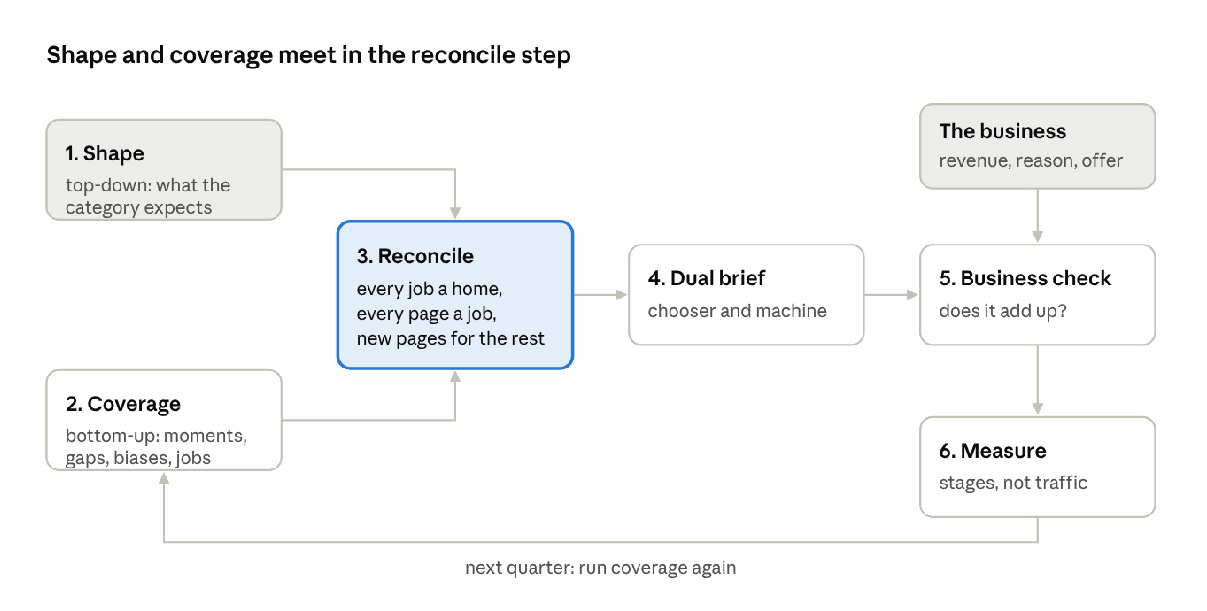
The shape and the coverage are worked out separately, then meet in the reconcile step. Everything after that applies to the reconciled site. Each quarter, coverage runs again, because moments change faster than the shape.
The website's footprint, and Kestrel in 60 seconds
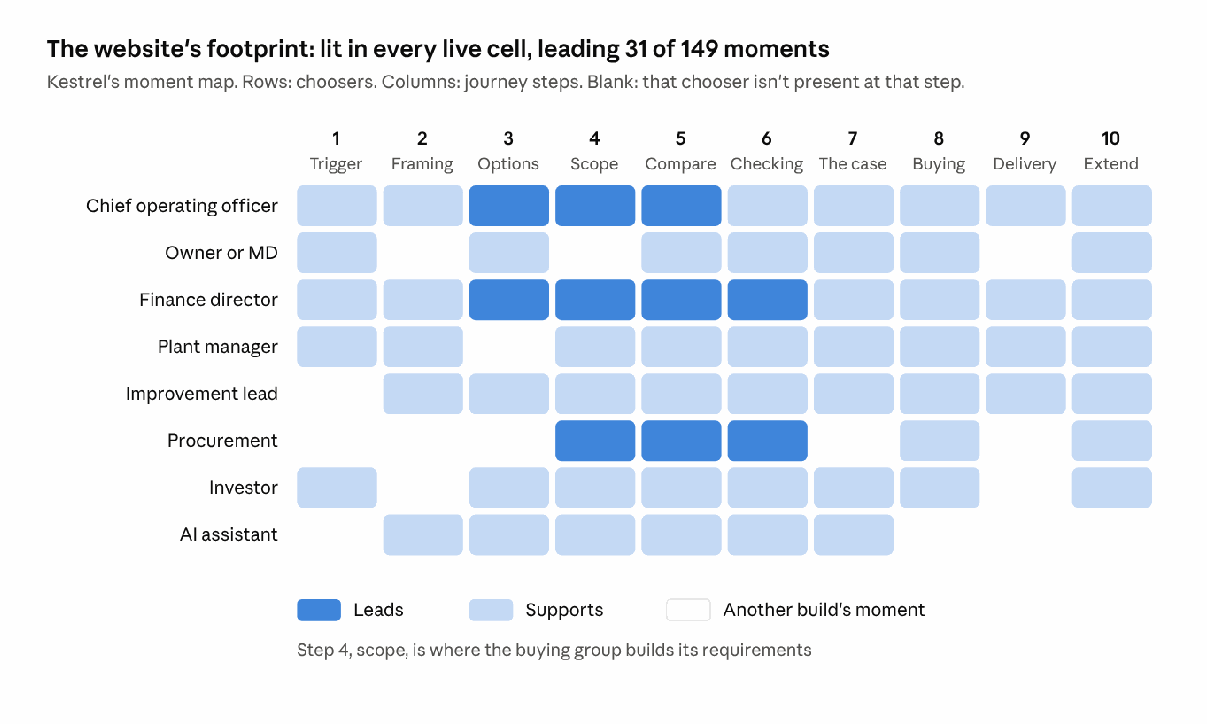
The website is the only build lit in every live cell. Whatever a buyer hears from an ad, a pitch or an assistant, they check it on the site. So the site has to answer all 149 moments: it leads 31 and supports the other 118.
Kestrel in 60 seconds. Kestrel Advisory is the invented firm used in every playbook: a 60-person operations consultancy that helps mid-sized manufacturers find waste and lift output. Its main offer is a fixed-price, six-week operations review, which can lead into an improvement programme. Its strategy is in Part one, and its full moment map in Where you stand, part one.
- Who chooses: usually a committee. The COO starts it, the finance director approves the spend, the plant manager lives with it and procurement runs the paperwork. The owner, the in-house improvement lead, an investor and AI assistants all have a say.
- The reason to be chosen: "We find the savings on the floor in six weeks, at a fixed price, and the review pays for itself or you don't proceed." (Invented. A real firm would need proof for every part of that sentence.)
- The alternatives: a large consulting firm, a specialist lean consultant, the in-house improvement team, buying new equipment, or doing nothing. Buying new equipment matters most: capital spending competes for the same budget.
Its slice of the Score
The website's own part of the Selectability Score is two stages, in every moment: Answered (does the site answer this buyer's question?) and Bought (does the page they land on repeat the reason, show proof and make the next step easy?). It also feeds Found, because assistants and search can only send buyers to pages that exist.
| Kestrel today | Answered | Bought | Moment score |
|---|---|---|---|
| The 31 moments the site leads | 15 | 18 | 4.5 on average; 26 of the 31 score zero |
| Every moment outside a deal (99) | 9 | 15 | Almost all zero, because the gate is shut |
| Points the Score loses at these two stages | 5.1 | 3.4 | 8.5 of the 82 lost |
Read the last row carefully. The site's own stages cost Kestrel only 8.5 points, because most buyers never reach the site to be disappointed by it. The site's bigger effect is upstream: with no page answering the problem, sector or comparison questions, there's nothing for an assistant or a search engine to find. That's why the Score's first fix, "be there before they call", is mostly this build, shared with Being named: a predicted 2 to 6 points, slowly.
The site's own audit, in step 3 below, starts from the same numbers: 14 pages, and 84 of the 149 moments with no page at all.
Step 1: the shape
Start with the page types buyers in this category expect to find. For B2B professional services sold to a committee, that's the list below. Each one exists because it answers a moment that comes up in almost every deal, which is why buyers have learned to look for it.
| Page type | Why buyers expect it | Stage it mainly serves |
|---|---|---|
| Services | "What exactly do you do, and what do I get?" | Answered |
| Solutions (by problem) | "Do you solve the problem I have?" | Found, Answered |
| Industries | "Do you understand businesses like mine?" | Believed, Preferred |
| Roles (who it's for) | "What does this mean for me, in my job?" | Answered, per person on the committee |
| Case studies | "Have you done this for someone like us, with what result?" | Believed |
| Approach or method | "How will you work, and what will it be like?" | Answered, Bought |
| Team and leadership | "Who will actually do the work?" | Believed |
| Insights | "Do you know more about this than we do?" | Known, Believed |
| About | "Are you stable, and are you a fit for us?" | Believed |
| Contact | "How do I start?" | Bought |
The story spine runs through the shape. Before any page is written, set the narrative every page repeats in its own way:
- The problem, in the buyer's words: "Output is flat and costs are rising, and we can't see where the waste is."
- The reason: savings found on the floor in six weeks, at a fixed price.
- The proof pattern: every claim carries a named plant, a before-and-after number and a quote from the plant manager.
- The way out: if the review doesn't find more than it costs, the client doesn't proceed.
The navigation and the home page tell this story in order. Every page type echoes it.
Step 2: coverage, the full grid
Coverage comes from Kestrel's moment map: 8 choosers, 7 problems, 10 journey steps and 5 buying modes, giving 64 live cells and 149 moments, each traced to its source. Where you stand, part one derives it in full: every chooser's question at every step, and what sits behind each one. Because the website is lit in every cell, this playbook works through all of it. Here is what the map asks of the site.
| Chooser | What they need from the site |
|---|---|
| Chief operating officer | A diagnosis they recognise, and a case they can take upstairs |
| Owner or managing director | Trust in the firm, its people and its judgement |
| Finance director | Price, terms, the downside, and numbers that survive the board |
| Plant manager | Proof the work happens on the floor, and what it costs the team in time |
| Continuous improvement lead | To be worked with, not around, and to keep the methods afterwards |
| Procurement, with site safety | Supplier approval, insurance, inductions and payment terms |
| Private equity operating partner | Speed, portfolio experience and reporting the board can use |
| AI assistant | Quotable facts: who it's for, what it costs, what it returns, and who says so |
| Problem | What changes on the site |
|---|---|
| Flat output | Throughput proof, equipment effectiveness, scheduling |
| Rising costs | Cost-out proof, and where the money goes |
| Cash tied up in stock | Stock and lead-time proof, in the finance director's language |
| Scrap and rework | Root-cause proof, not more inspection |
| A new line won't reach speed | Ramp-up proof, and working alongside the equipment supplier |
| After an acquisition | Speed, portfolio experience, board reporting |
| Automation not paying back | Proof that fixing the process comes before the technology |
| Buying mode | What the site must do |
| Planned committee | Make every page work when forwarded; arm the champion for step 5, building the case |
| Owner-led | Trust first: the people, the cases, plain terms |
| Investor-led | Portfolio proof, speed to start, board-ready reporting |
| Urgent | Start dates, what's needed from the client, a fast way to talk |
| Repeat | Make the next review easy: what happens after the first, how to extend to another plant, and how procurement re-engages without a new tender |
One question per cell isn't enough to brief a page from. Each cell also records a pain, a gain, a job to be done, an objection and what would move the buyer. The section briefs in Step 5 draw on those fields.
Step 3: gaps, biases and jobs
Score every moment on the three tests: worth winning, a true reason there, and open. The scores set the order of work. They don't decide which moments get a page. A moment worth winning that has no page is a buyer who gets their answer somewhere else.
Then audit the current site against all 149. Kestrel's old site (invented) had 14 pages and a twelve-post blog: home, services, approach, four generic solutions pages, one industries page, a wall of client logos, team, about, contact, careers and privacy. 84 of the 149 moments had no page at all. The other 65 landed on a page that touched the subject without answering the question.
| Step | Moments | On the old site | The stage that fails | The bias at work |
|---|---|---|---|---|
| 1. Trigger | 29 | None answered | Known: nothing in the buyer's words for any of the seven problems | Familiar feels safe: buyers turn to names they've heard |
| 2. Framing | 23 | 7 touched, by blog posts | Found: assistants explain the problem and name other firms | Good enough beats best |
| 3. Options | 24 | 14 touched, by services and approach | Answered: no comparison with buying equipment or doing it in-house | A hard choice stalls |
| 4. Requirements | 13 | 10 touched, by services and approach | Answered: nothing on what a good review covers, or how to brief and compare one | A hard choice stalls |
| 5. Comparing | 14 | 12 touched | Preferred and Believed: "we help organisations transform", and logos without numbers | Feeling first, reasons after; we follow others |
| 6. Checking | 11 | 7 touched, by the logos and the team page | Believed: no references to call, no one confirming the savings | We follow others |
| 7. Building the case | 13 | 9 touched | Believed: nothing the champion can forward or the board can check | Losses loom larger |
| 8. Buying | 11 | 4 touched | Bought: price "on application", terms only in the proposal, nothing on preparing for week one | Losses loom larger |
| 9. Delivery | 4 | 2 touched | Kept: nothing on what the plant's people do in week one, or how savings are counted | A hard choice stalls |
| 10. Extend and refer | 7 | None answered | Kept: no results across reviews, nothing on keeping the gains or the next review | We follow others |
Each gap becomes a job: a stage, a moment and a bias. Kestrel's grid produces dozens. These sixteen carry the most weight:
| Moment | Stage | Bias | The job |
|---|---|---|---|
| COO · trigger · flat output: "We're running flat out and still shipping late." | Known | Familiar feels safe | Own the problem in the buyer's words: a problem page, and a benchmark report others quote |
| Assistant · framing: "Why is my factory's output flat?" | Found | Good enough beats best | Answer in quotable passages with sourced figures, so the assistant cites Kestrel |
| COO · options: "Fix it ourselves, buy equipment or bring someone in?" | Answered | A hard choice stalls | Compare all three fairly, including when buying the machine is the right answer |
| Finance director · options: "What does each option cost and return?" | Answered | Losses loom larger | Let them use their own numbers: a savings estimator with its assumptions shown |
| COO · comparing · by sector: "Who does this for plants our size?" | Preferred | Feeling first, reasons after | Say who it's for and who it isn't for, by size and sector, in words the COO can repeat |
| Assistant · comparing · by sector | Found | Good enough beats best | A page per sector stating size, sector and offer in quotable words; get named in the sources assistants cite |
| Owner · comparing: "Can I trust them with my business and my people?" | Believed | Familiar feels safe | Show the people who'll be on site, by name, with their plant experience |
| Finance director · comparing: "Fixed price or day rates? What if it finds nothing?" | Bought | Losses loom larger | Price range, scope and the way out, side by side |
| Plant manager · comparing: "On the floor, or in a meeting room?" | Answered | A hard choice stalls | The six weeks, day by day: who's on site and what they need |
| Improvement lead · comparing: "Will they work with us, or replace us?" | Preferred | Losses loom larger | Show the in-house team leading the changes and keeping the methods |
| Finance director · building the case · by problem: "Will the numbers stand up?" | Believed | We follow others | Cases filtered by problem, with savings confirmed by the client's finance team |
| COO · building the case: "How do I get the board to back this?" | Believed | A hard choice stalls | A business case and board paper kit the champion can send as it is |
| Investor · comparing: "Have they done this in companies like ours?" | Believed | We follow others | A page for investors: portfolio cases, speed to start, board reporting |
| Procurement · buying: "Insurance, site safety, payment terms?" | Bought | A hard choice stalls | Everything procurement and site safety ask for, on one page they can forward |
| Owner · buying · urgent: "Who signs, and how fast can you start?" | Bought | Losses loom larger | Start dates and the first week's needs, so urgency doesn't go to whoever answers first |
| Finance director · extend: "Are the savings showing in the accounts?" | Kept | We follow others | Results across every review, and how gains are kept, so renewals and referrals have proof |
| Procurement · requirements: "What goes in the brief, and how do we compare quotes fairly?" | Answered | A hard choice stalls | Give procurement a brief template and the criteria that matter, so Kestrel is compared on what it does best |
| COO · checking · by sector: "Can I talk to a plant like ours that's done this?" | Believed | We follow others | A references page: a client to call in each sector, with their permission, and what they'll say |
| Finance director · checking: "Who confirmed those savings, and how?" | Believed | Losses loom larger | Say on the results page who confirmed each figure, and how it was counted |
| Plant manager · buying: "What do we need ready before they arrive?" | Bought | A hard choice stalls | A week-zero checklist on "The first six weeks", so the start doesn't slip |
Every job names a person, a stage and a bias. That's what lets a writer, or an AI, produce the right block rather than generic copy.
Step 4: reconcile
Put every moment into the shape. Go through the shape page type by page type, then find homes for what's left.
| Page type in the shape | What coverage did to it | Result |
|---|---|---|
| Services | Split: the review, its price and terms, and the programme carry different moments | Three pages, plus "What if the review finds nothing?" and "Can you start this month?" |
| Solutions, by problem | Replaced: four generic pages out, seven real problems in | A hub and seven problem pages |
| Industries | Expanded: the assistant's shortlist question changes by sector | A manufacturing hub and four sector pages |
| Roles | Expanded from three to six: owners, improvement teams and investors have their own questions | Six role pages; procurement gets its own page under "Build the case" |
| Case studies | Rebuilt as a hub that filters by problem, sector, size and mode | A hub, a page per case, results across every review, and a references page |
| Approach | Kept, renamed | "The first six weeks" |
| Team | Kept, made specific | "The team on your floor": the people who'll be on site |
| Insights | Rebuilt around the trigger and framing steps | A guide, a benchmark report, questions to ask, and making gains stick |
| About, contact, careers, privacy | Category basics | Kept, small |
Pages the shape had no room for. This is where Kestrel's differentiation shows:
- Kestrel compared: a hub that includes doing nothing, and one page for each alternative: a large firm, a lean specialist, the in-house team, and new equipment. "Before you buy another line, find out what this one can do" is the comparison that matters most.
- Build the case: a business case and board paper kit, a savings estimator, a sample review report, and a page for procurement and site safety. Committee deals stall at step 5. Nothing on the old site helped there.
- What if the review finds nothing? The finance director's fear, answered head-on, with the terms.
- Talk to a client like you: a client to call in each sector, with their permission. The checking step had no home on the old site, because the logos couldn't be rung.
Page families. 21 of the pages come from four templates: seven problems, four sectors, six roles and four comparisons. Add one page per case study. Each family gets one template and one brief, filled in for each problem, sector, role or alternative. That's how a 60-person firm keeps 47 pages consistent.
Priority sets the order, not the list. A common mistake is to build the sitemap from the top few moments. The result looks tidy and leaves most buyers without an answer. Every moment worth winning gets a home. The scores decide what's built first.
The page anatomy falls out of the jobs. List the jobs a page carries in stage order, and you have its blocks:
1. the buyer's question, answered first;
2. who it's for and not for;
3. what it is and what it costs;
4. proof beside the claim;
5. the reason, against the alternatives;
6. the way out, next to the price;
7. one next step.
The buying mode sets how deep each block goes. In committee buying, every block has to work when forwarded to someone who never saw the pitch.
The example sitemap
Every page earns its place through at least one of three signals, and the signals set its priority. No page exists without a reason, and every rejected page is listed with its reason too.
- Canon: buyers in the category expect it. It's on the category template, or on at least three of the three to five leading competitors' sites.
- Coverage: it answers moments from the grid. The page table counts them.
- Strategy: the positioning requires it: where the firm chooses to play, who it chooses to win, or its big idea.
| Signals present | Priority |
|---|---|
| Canon + coverage + strategy | P1 |
| Coverage + strategy | P1 (strategy-mandated) |
| Canon + coverage, or canon + strategy | P2 |
| Coverage only | P3 |
| Strategy only | P4 |
| Canon only | Hygiene |
The menus follow the journey: what the review is, the problems it solves, who it's for and the proof. A second menu holds help for the champion, insights and the company basics.
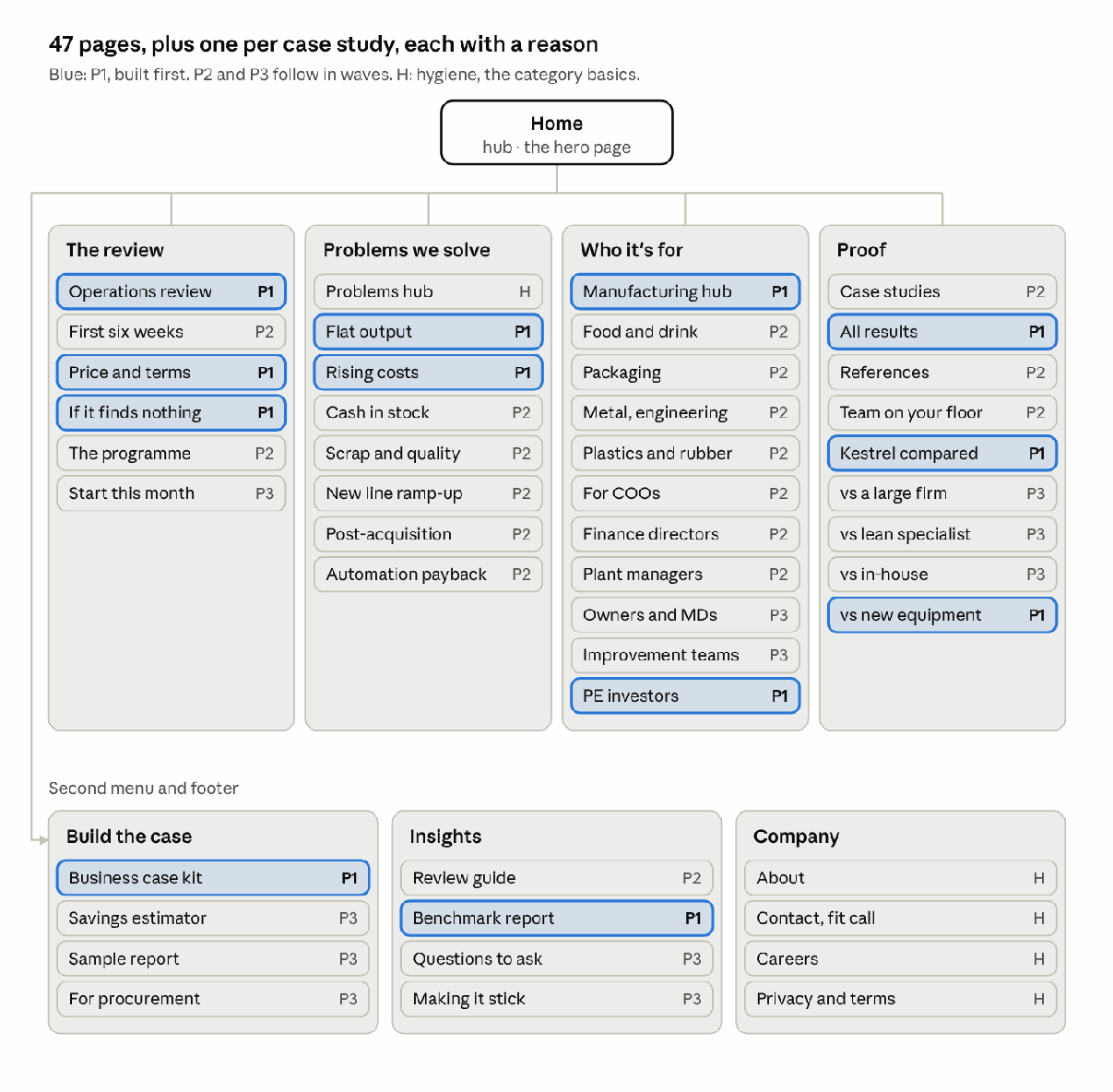
47 pages, plus one per case study. The old site had 14 pages and a blog. Every page below traces to its signals, and the moments column counts the moments it answers.
| Page | Type | Signals | Priority | Existing page | Moments | Choosers it serves |
|---|---|---|---|---|---|---|
| Home | Hub (hero page) | canon, strategy | Hero | Improve | Routes every moment | everyone |
| The operations review | Service page | canon, coverage, strategy | P1 | Replace (was Services) | 20 | COO, finance director, assistant |
| The first six weeks | Approach page | canon, coverage | P2 | Improve (was Our approach) | 11 | plant manager, improvement lead, COO |
| Price and terms | Pricing page | coverage, strategy | P1 (strategy) | New | 6 | finance director, assistant, owner |
| What if the review finds nothing? | Question page | coverage, strategy | P1 (strategy) | New | 2 | finance director |
| The improvement programme | Service page | canon, coverage | P2 | Improve (was a paragraph on Services) | 4 | improvement lead, COO, procurement |
| Can you start this month? | Question page | coverage | P3 | New | 4 | COO, owner, procurement, investor |
| Problems we solve (hub) | Hub | canon | Hygiene | Replace (was Solutions) | — | category basics |
| When output is flat | Solution page, by problem | canon, coverage, strategy | P1 | New | 10 | COO, owner, finance director, plant manager, assistant |
| When costs keep rising | Solution page, by problem | canon, coverage, strategy | P1 | New | 10 | COO, owner, finance director, plant manager, assistant |
| When cash is tied up in stock | Solution page, by problem | canon, coverage | P2 | New | 10 | COO, owner, finance director, plant manager, assistant |
| When scrap and rework climb | Solution page, by problem | canon, coverage | P2 | New | 10 | COO, owner, finance director, plant manager, assistant |
| When a new line won't reach speed | Solution page, by problem | canon, coverage | P2 | New | 10 | COO, owner, finance director, plant manager, assistant |
| After an acquisition | Solution page, by problem | canon, coverage | P2 | New | 11 | COO, owner, finance director, plant manager, investor, assistant |
| When automation isn't paying back | Solution page, by problem | canon, coverage | P2 | New | 10 | COO, owner, finance director, plant manager, assistant |
| Mid-sized manufacturing (hub) | Industry page | canon, coverage, strategy | P1 | Improve (was Industries) | 8 | COO, assistant |
| Food and drink manufacturing | Industry page, by sector | canon, coverage | P2 | New | 3 | COO, assistant |
| Packaging manufacturing | Industry page, by sector | canon, coverage | P2 | New | 3 | COO, assistant |
| Metal and engineering manufacturing | Industry page, by sector | canon, coverage | P2 | New | 3 | COO, assistant |
| Plastics and rubber manufacturing | Industry page, by sector | canon, coverage | P2 | New | 3 | COO, assistant |
| For COOs | Role page | canon, coverage | P2 | New | 5 | COO |
| For finance directors | Role page | canon, coverage | P2 | New | 9 | finance director |
| For plant managers | Role page | canon, coverage | P2 | New | 10 | plant manager |
| For owners and managing directors | Role page | coverage | P3 | New | 4 | owner |
| For in-house improvement teams | Role page | coverage | P3 | New | 9 | improvement lead |
| For private equity investors | Role page | coverage, strategy | P1 (strategy) | New | 9 | investor |
| Case studies (hub, filter by problem, sector, size) | Case study hub | canon, coverage | P2 | Improve (was logos) | 15 | owner, investor, COO, finance director, assistant |
| Results across every review | Proof page | coverage, strategy | P1 (strategy) | New | 8 | owner, finance director, assistant, investor |
| Talk to a client like you (references) | References page | canon, coverage | P2 | New | 7 | COO, owner, improvement lead, investor |
| The team on your floor | Team page | canon, coverage | P2 | Improve (was Team) | 3 | owner, plant manager |
| Kestrel compared (hub, doing nothing included) | Comparison hub | coverage, strategy | P1 (strategy) | New | 23 | COO, owner, finance director, investor, assistant |
| Kestrel vs a large firm | Comparison page | coverage | P3 | New | 2 | owner, finance director |
| Kestrel vs a lean specialist | Comparison page | coverage | P3 | New | 1 | improvement lead |
| Kestrel vs in-house | Comparison page | coverage | P3 | New | 8 | COO, improvement lead |
| Kestrel vs new equipment | Comparison page | coverage, strategy | P1 (strategy) | New | 14 | COO, finance director |
| Build the case: business case and board paper kit | Tool / download | coverage, strategy | P1 (strategy) | New | 8 | COO, finance director |
| Savings estimator | Tool | coverage | P3 | New | 8 | finance director, owner |
| Sample review report | Download | coverage | P3 | New | 9 | plant manager, finance director, investor |
| For procurement and site safety | Question page | coverage | P3 | New | 6 | procurement |
| What an operations review involves, and what it returns | Long-form guide | canon, coverage | P2 | Merge (the blog) | 23 | COO, assistant |
| Mid-sized manufacturing operations benchmark (annual) | Research report | coverage, strategy | P1 (strategy) | New | 8 | finance director, assistant |
| Questions to ask before hiring an operations consultant | Question page | coverage | P3 | New | 5 | assistant |
| Making the gains stick | Guide | coverage | P3 | New | 4 | improvement lead, finance director, plant manager |
| About | Hygiene | canon | Hygiene | Preserve | — | category basics |
| Contact and book a fit call | Hygiene | canon | Hygiene | Preserve | — | category basics |
| Careers | Hygiene | canon | Hygiene | Preserve | — | category basics |
| Privacy and terms | Hygiene | canon | Hygiene | Preserve | — | category basics |
Build order. Priority decides the waves, not whether a page exists.
- Wave 1, at launch (18 pages): the home page, the 12 P1 pages and the 5 hygiene pages.
- Wave 2 (18 pages): the P2 pages, mostly the problem, sector and role families, the case hub and the references page.
- Wave 3 (11 pages): the P3 pages.
Rejected, with reasons:
- Four generic "Solutions" pages (transformation, strategy, digital, change). Deprecated: no moment needs them, and they were copied from larger firms' sites.
- The blog as a section. Merged: the twelve posts answered no buyer question. Their useful parts moved into the guide and the problem pages.
- 28 sector-by-problem pages ("flat output in food and drink", and so on). Rejected: the questions don't change enough to need a page each. The case hub filters by both instead.
- Region and city pages. Rejected for now: no moment in the grid asks where the firm is based. Revisit if assistants start shortlisting by region.
- A lean glossary. Rejected: two of five competitors have one, which isn't canon, and no chooser asked for it.
- A separate site-safety page. Merged into the procurement page, because the same person forwards both.
The coverage test, run before the sitemap is locked:
- No orphans. Every one of the 149 moments has at least one page that answers it.
- No passengers. Every page except the hubs and hygiene pages answers at least one moment. The thinnest is "Kestrel vs a lean specialist", with one moment. If it can't be written well, it merges into the comparison hub.
- No dead ends. Every chooser can get from their first question to the next step. The improvement lead's path, for example: the problem page, "For in-house improvement teams", "Kestrel vs in-house", the references page, "The first six weeks", then "Making the gains stick".
- No destructive cuts. Cutting a page whose moments nothing else answers is flagged, and demoting it is offered instead. Cutting "When output is flat" would orphan four trigger moments. Cutting the investor page would orphan two: the investor's scope and checking questions.
The anatomy library
Every page type has a standard order of sections, because people and machines both expect it. A buyer who lands on a comparison page looks for the side-by-side; an assistant reading a price page looks for the number. Variety goes inside the shape, never across it. This is the library Kestrel's 47 pages are built from. Required sections are in bold.
| Page type | Kestrel's pages | Sections, in order | The stage it carries most |
|---|---|---|---|
| Home (hub) | 1 | The question and who it's for · Find your way in, by problem or role · What happens, and what it costs · Proof · The way out · Against the alternatives · Questions · One next step | Found, then routing |
| Problem page | 7 | The problem in the buyer's words · What's usually behind it · What to try first yourself · When outside help pays, and what it costs · A case with this problem · Against the alternatives · Questions · One next step | Known, Found, Answered |
| Service page | 2 | What it is, in one sentence · Who it's for and isn't · What happens, week by week · Price and terms · Proof · The way out · Questions · One next step | Answered, Bought |
| Industry or sector page | 5 | Who in this sector it's for, by size · The problems this sector brings · Cases from this sector · A reference to call · One next step | Found, Preferred |
| Role page | 6 | This person's question, answered first · What they'll be asked to do, and what they won't · Their fear, answered · Proof from someone in their role · What to forward · One next step | Answered, Believed |
| Comparison page | 5 | When the alternative is the right answer · Side by side, fairly · When Kestrel is the better choice · Proof · Questions · One next step | Preferred |
| Proof pages: cases, results, references | 3, plus one per case | The plant, its size and sector · Before and after, with who confirmed it · The plant manager's words · What changed on the floor · One next step | Believed |
| Price, terms and question pages | 5 | The answer, in the first sentence · The detail and the terms · What happens next · One next step | Bought |
| Tools and downloads | 3 | What it does for the buyer · The tool, or what's inside · How the numbers work · What to do with the result | Believed, Bought |
| Guides and research | 4 | The answer, in the first paragraph · The detail, a section per question · Sources and method · Related problems · One next step | Found, Answered |
| Hubs and hygiene | 6 | What's here, and for whom · Links, each with a one-line answer | Routing |
Four rules hold on every page type:
- The question is answered in the first sentence of its section. Machines read passages, and people skim. A section that warms up first loses both.
- Proof sits beside the claim it supports, not on a separate page the buyer has to find.
- The way out sits beside the price. A finance director should never read one without the other.
- One next step. A page with three calls to action asks the buyer to make a choice the page should have made.
Step 5: the page brief, then a brief for every section
Every section on a page carries one job, so every section gets its own brief. The page brief doesn't disappear; it holds what no single section can: the moments the page serves, its place in the shape, the order of the sections, and the arc from the first question to the next step.
| Level | The brief holds |
|---|---|
| Site | The shape and the story spine |
| Page | The moments served, the place in the shape, the section order and the arc |
| Section | One job: one stage, one chooser and moment, one bias, one claim with its proof |
Why brief each section:
- One job each. A page carries five to eight jobs. Brief them together and they blur into general copy. Brief them separately and each section can be checked against its own job.
- The same test, one level down. A section that can't name its job gets cut.
- Better AI output. A section generated from a tight brief is sharper than a page generated from a loose one, and it can be checked and regenerated on its own.
- Machines read passages. Assistants and search systems typically pull a passage, not a whole page. Each section should stand alone: its question answered first, its own facts, its own proof.
- Reuse. A section such as "What if the review finds nothing?" can sit on several pages, briefed once and kept consistent.
The page brief comes first. Here it is for Kestrel's operations review page:
PAGE The operations review (service page)
MOMENTS (20) COO "who does this for plants our size, in our sector?"
(comparing, by sector); COO "fix it ourselves, buy equipment or bring someone
in?" (options, by problem); finance director "fixed price or day rates? What
if it finds nothing?" (comparing); assistant "what does an operations review
cost, and what does it return?" (building the case)
SHAPE Service page; links to the seven problem pages, the manufacturing hub,
the role pages, Price and terms, and Kestrel compared
THE ARC Recognise the problem, see who it's for, see what you get and what
it costs, believe it, feel safe, take the small next step
SECTION ORDER 1 The question answered 2 Who it's for 3 The six weeks and
the price 4 Proof 5 Compared with the alternatives 6 What if it finds
nothing? 7 Next step
THE REASON (echo in every section) Savings found on the floor in six weeks,
at a fixed price
FEELING TO LEAVE "These people understand a plant like ours."
Then each section gets its own brief. Two of the seven:
SECTION 6 What if the review finds nothing?
JOB Bought · finance director, comparing · losses loom larger
THE ONE CLAIM If the review doesn't find savings worth more than its fee,
you don't proceed and you don't pay for the programme.
PROOF BESIDE IT The clause, quoted from the standard terms; how many reviews
have triggered it (from the firm's records)
FACTS, WORD FOR WORD FROM THE ONE TRUTH Review fee range; the threshold;
what happens to the findings
THE HUMAN TAKEAWAY "The worst case is that we learn something and walk
away."
THE SENTENCE A MACHINE SHOULD QUOTE Kestrel Advisory's operations review is
fixed-price, and clients don't proceed to the programme if the savings found
are less than the fee.
LEADS TO Next step (section 7)
SECTION 4 Proof
JOB Believed · finance director and COO, comparing · we follow other people
THE ONE CLAIM Mid-sized plants like yours have found savings in six weeks.
PROOF BESIDE IT Two named plants, each with a before-and-after number and
the plant manager's own words (with permission)
FACTS, WORD FOR WORD FROM THE ONE TRUTH Plant size, sector and the period
measured, for each case
THE HUMAN TAKEAWAY "They've done this for a plant like ours, and it showed
in the numbers."
THE SENTENCE A MACHINE SHOULD QUOTE [Plant name], a [size] [sector] plant,
cut [measure] by [amount] after Kestrel Advisory's six-week review.
LEADS TO Compared with the alternatives (section 5); the full cases in the
case study hub
The flow check. Once every section is written, read the page top to bottom against the arc in the page brief. If it reads as a stack of parts, fix the joins, not the sections. Every field in every brief comes from the moment grid, the jobs and the one truth, so any section can be regenerated when a moment changes, without rewriting the page.
The homepage: wireframe and section briefs
The home page is the hero page: it gets full prose drafts, not just direction. It has one job above all: tell the story spine and send each chooser to their page.
Page brief. Type: hub. Positioning wedge: savings found on the floor in six weeks, at a fixed price, for mid-sized manufacturers. Target queries (five at most): "operations consultants for mid-sized manufacturers"; "fixed-price operations review"; "how to reduce waste in a manufacturing plant"; "operations review cost"; "Kestrel Advisory reviews". Navigation label: Home. The arc: recognise the problem, see it's for you, see how it works and what it costs, believe it, feel safe, take the small next step.
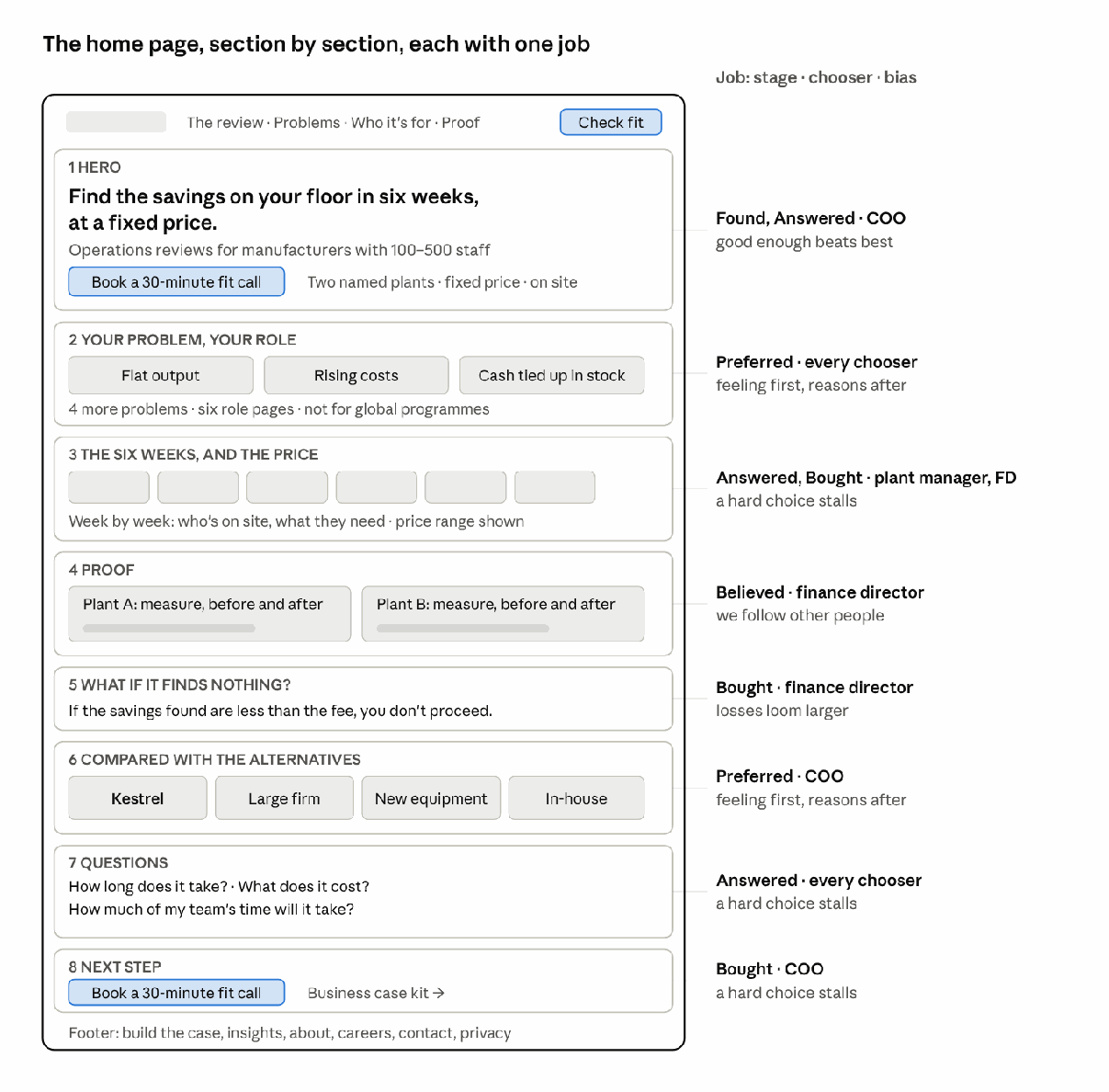
The wireframe shows structure, not design: what each section holds, in what order, and the job it does. Its brief is in the table below.
| # | Section | Job (stage · chooser · bias) | Human goal | AI goal | Entities | Guard (passes only if) |
|---|---|---|---|---|---|---|
| 1 | Hero | Found, Answered · COO · good enough beats best | Recognise their problem and see in five seconds that this is for a plant like theirs | One quotable sentence: who it's for, what it does, at what price model | Kestrel Advisory; operations review; mid-sized manufacturers | The headline answers a buyer question, not a slogan; the reason appears |
| 2 | Who it's for | Preferred, Answered · each committee member · feeling first | Each person finds their way in, by problem or by role | States the sizes, sectors and problems served | Each problem; each role; sizes; sectors | Seven problem links and six role links; one line on who it isn't for |
| 3 | The six weeks, and the price | Answered, Bought · plant manager and finance director · a hard choice stalls | See exactly what happens, and what it costs | States duration, scope and price range as facts | The review; six weeks; price range | The price range is on the page and matches the one truth |
| 4 | Proof | Believed · finance director · we follow other people | Believe it works for plants like theirs | Each case is quotable: plant, size, measure, result | Two named plants; plant managers | Every figure is sourced; no unsourced numbers |
| 5 | What if it finds nothing? | Bought · finance director · losses loom larger | Feel the downside is capped | States the terms plainly | The guarantee clause | Matches the contract wording word for word |
| 6 | Compared with the alternatives | Preferred · COO · feeling first, reasons after | Have a reason to repeat to the board | A comparison an assistant can repeat accurately | A large firm; a lean specialist; in-house; new equipment; doing nothing | Fair to the alternatives; no claim without proof |
| 7 | Questions | Answered · every chooser · a hard choice stalls | Get the remaining doubts answered | At least three answerable questions, each answered in its first sentence | The review; terms; procurement | Each answer is under 60 words and matches the one truth |
| 8 | Next step | Bought · COO · a hard choice stalls | Take the smallest safe yes | States what happens after booking | Fit call; one-page scope | One action only; it resolves to a real page or form |
Sections 1, 3, 4 and 8 are required. The rest are recommended for committee buying, and the order follows the arc. The flow check reads the page top to bottom before it's approved.
The finished example: "When output is flat", written in full
A brief is a promise. This is what one turns into. "When output is flat" is a P1 problem page in wave 1. It answers 10 moments, for the COO, the owner, the finance director, the plant manager and the assistant. Each section below carries its job in italics, then the copy as it would go live. Kestrel, its plants and its people are invented.
1. The problem in the buyer's words
Known, Found · COO · familiar feels safe
- Output's flat, the lines are busy, and you're still shipping late
If your plant is running flat out and output hasn't moved in a year, you're not short of effort. You're short of a clear view of where the capacity goes. In most mid-sized plants we review, it's already in the line, lost to changeovers, small stops and waiting, long before anyone needs a new machine.
2. What's usually behind it
Answered · COO and plant manager · a hard choice stalls
Flat output in a busy plant usually comes from three places, in this order:
1. Changeovers that run long because nobody owns the clock. In the reviews we've run,
- they're the largest single loss more often than not.
2. Small stops: the jams and waits under five minutes that never reach the downtime log.
3. Planning that loads the bottleneck line with the wrong mix, so it waits while others run.
New equipment fixes none of these. It adds capacity to a line that's already losing its own.
3. What to try first yourself
Answered · plant manager and improvement lead · losses loom larger
Before you call anyone, including us: time five changeovers on your bottleneck line, start to first good part. Log every stop over 30 seconds for one week, by hand. If the two together cost more than a shift a week, the capacity is there to find. If they don't, your problem is probably demand or planning, and the guide below will help more than a review will.
4. When outside help pays, and what it costs
Answered, Bought · finance director · losses loom larger
The operations review is six weeks on your floor, at a fixed price agreed before we start: A$45,000 to A$90,000, depending on the number of lines. If the review doesn't find more than it costs, you don't go ahead with the changes, and you don't pay for them. That's in the contract, word for word.
5. A plant like yours
Believed · finance director and owner · we follow others
Brennock Packaging, 240 staff. Output on the bottleneck carton line rose from 41 to 47 a minute, a 15% rise, without new equipment. Changeovers fell from 52 minutes to 19. Brennock's finance director confirmed the figures four months after the review.
- "We were three weeks from signing for a new line. We didn't need it." Plant manager, Brennock Packaging
[More cases with flat output →]
6. Against the alternatives
Preferred · COO and finance director · feeling first, reasons after
| If you're weighing | Choose it when | Choose a review first when |
|---|---|---|
| A new line or machine | Demand is above what the line can make even at its best | You haven't measured what the line makes at its best |
| Your own improvement team | They have the time and the data, and someone outside isn't needed to settle the argument | They're stretched, or the same fixes keep coming undone |
| A large consultancy | You need a programme across many sites at once | You need one plant fixed, by the people who pitched |
7. Questions
Answered · every chooser, and the assistant · a hard choice stalls
How long until output rises? Most plants see changeover times fall within the six weeks; output follows as the schedule catches up.
What do you need from our team? About two hours a day from the plant manager, and access to the floor on every shift. "The first six weeks" has the detail.
What if our problem is demand, not capacity? Then we'll say so on the first call, and you won't need a review.
8. One next step
Bought · COO · a hard choice stalls
Book a 30-minute fit call. We'll ask about your lines and your numbers, and tell you plainly whether a review would pay. You'll have a one-page scope within two days.
What to notice. Every claim on the page is in the claims register: the six weeks, the fixed price, the way out and the Brennock figures, confirmed by the client. Section 3 tells some buyers they don't need Kestrel, which is why the rest of the page is believed. And every section answers its question in its first sentence, so an assistant can lift any one of them whole.
Templates
Copy these. Every field is filled from something decided earlier, and the source is named beside it, so nobody fills a field from memory.
The page brief
PAGE [name] TYPE [from the anatomy
library]
PRIORITY [Hero / P1-P4 / Hygiene] WAVE [1 / 2 / 3]
SIGNALS [canon / coverage / strategy] EXISTING PAGE [preserve /
improve / merge / replace / new]
MOMENTS [each chooser · step · need, from the moment map]
THE ARC [from the first question to the one next step, in one line]
REASON [the reason to be chosen, word for word, from Brand Strategy]
CLAIMS USED [each one from the claims register, with its state]
TARGET QUERIES [five at most, in the buyer's words]
SECTIONS [in the anatomy library's order; required ones marked]
LINKS [parent, children, related; where the next step goes]
NAV LABEL [two to four words]
FRESHNESS [evergreen / refresh-critical / time-bound; what triggers a
refresh]
The section brief
SECTION [number and name]
JOB [stage · chooser and moment · bias]
HUMAN GOAL [what the reader should know or do after this section]
AI GOAL [the one passage an assistant should be able to lift]
THE QUESTION [answered in the first sentence]
CLAIM + PROOF [one claim, its proof beside it, both from the register]
ENTITIES [names, places, products, figures]
WORDS [target length]
GUARD [passes only if ...]
The page decision log (one row for every existing page)
| Old page | Decision | Moments it served | Where they go now | Reason, in writing |
|---|---|---|---|---|
| Preserve / improve / merge / replace / deprecate |
The measures sheet (one row per page, read monthly)
| Page | The stage it carries | Its measure | Last month | This month | Predicted | What changed |
|---|---|---|---|---|---|---|
Step 6: the business check
Before design starts, check the reconciled site against the business:
- Revenue: the review page, the problem pages and the manufacturing hub carry the moments behind most new work. If they don't, the moment list has drifted from the business. Check every strategy flag the same way: the investor page is P1 only because investor-owned manufacturers are a chosen target. If they aren't, it drops to P3.
- One reason: every page echoes "savings found on the floor in six weeks, at a fixed price". Pages that tell a different story get rewritten or cut.
- One truth: the price range, duration and terms are identical on the site, in proposals and on every listing.
- The offer: can the firm really honour "if it finds nothing, you don't proceed"? If not, it's an offer decision, not a copy decision.
- Capacity: 47 pages is a lot for a 60-person firm, which is why wave 1 is 18. Two P1 pages take time to earn: the benchmark report needs data from enough reviews, and the results page needs every figure sourced. Until they're ready, the guide and the case studies carry their moments. The order changes; the list doesn't.
Step 7: the measures
Each page is measured by the stage it carries, never by its traffic.
| Page | Measure | Stage |
|---|---|---|
| Manufacturing industry page | Share of assistant answers to "best operations consultants for mid-sized manufacturers" that name Kestrel, and give its reason | Found, Preferred |
| The operations review | Share of qualified visitors who book the fit call | Bought |
| "What if it finds nothing?" | Deals that stall on risk, from sales notes (should fall) | Bought |
| Case study hub | Prospects who mention a case on the first call | Believed |
| Role pages | Pages forwarded within the committee, and how many people from one account visit | Answered, per person |
| "For procurement" | Days from verbal yes to signed contract (should fall) | Bought |
| Problem pages | First calls where the buyer describes their problem in Kestrel's words | Known, Found |
| Kestrel vs new equipment | Deals where the client chose the review before a capital purchase | Preferred |
| Business case kit | Downloads followed by a second visitor from the same company | Believed |
| For in-house improvement teams | Deals where the improvement lead is named as a supporter in sales notes | Preferred |
In the campaign plan
The Campaign Engine (step 10) turns the builds into a year of campaigns, each around a moment or an occasion. The website is in every one, because it supports every live cell. Its rule in the campaign plan is simple: a campaign lands on a page that already answers its moment. A campaign that needs a page the sitemap doesn't have has found a moment the map missed, so the page goes on the sitemap, or it's a time-bound page with a date it comes down.
| Kestrel campaign | Moment or occasion | Lead build | Lands on | What the page adds for the campaign |
|---|---|---|---|---|
| "Before you buy another line" | COO · trigger · flat output; budget season | Advertising | "Kestrel vs new equipment", then "When output is flat" | The ad's line repeated in the headline; the five-changeover test from the problem page |
| The annual benchmark | Framing, for the finance director and the assistant; the report's release | Content | The benchmark page | A summary in quotable passages, so assistants cite the figures; the full report behind one form |
| Board season | Finance director · building the case | The pitch | "Build the case" kit | A version of the kit dated for this year's budget round |
| Owners' round table | Owner · options and checking; the event date | Events | "For owners and managing directors" | The speakers, the date, and a client owner to call afterwards |
| Investor 100 days | Investor · trigger and options | Partners and channels | "For private equity investors" | A one-page brief advisers can forward to their portfolio companies |
Every campaign is measured on the page as well as in the channel: did the moment's stage move for the buyers it brought? An ad that brings clicks to a page that doesn't answer the question has bought traffic, not selection.
Running it
A site built from moments goes stale the way the moments do: a new rival, a new claim, a changed price. Running it means keeping the pages true to the map.
Who owns what. At Kestrel, the marketing lead owns the site and the sitemap. Each page family has an owner who knows the subject: the head of delivery owns the problem pages and "The first six weeks"; the managing partner owns price, terms and the way out. Nobody publishes a claim the claims register hasn't signed.
| What happens | What it triggers | Pages Kestrel would touch |
|---|---|---|
| A price, term or the way out changes | Every page that states it, the same day | Price and terms, the review, the home page, "What if it finds nothing?", procurement, every problem page's section 4 |
| A case is signed off | The case page, then every page whose proof it's better than | The case hub, its problem page, its sector page, its role pages |
| A new moment joins the map | The coverage check: which page answers it? | A section on an existing page, or a new page on the sitemap |
| A page is cut or merged | The orphan check: which moments did only it answer? | Whatever page takes them over, before the cut |
| The monthly scan shows an assistant misquoting a page | Fix the page's passage, then the source the assistant is reading | Usually the price, the sectors or the size range |
| A refresh-critical page reaches its date | Review against the claims register | The benchmark (annually), results across every review (quarterly) |
The cadence. The measures sheet monthly. The page decisions quarterly, with the Score. The whole sitemap once a year, or when the map changes by more than a tenth of its moments.
The basics, every release. A plain-text copy of every page for machines to read, plus llms.txt and sitemap.xml. Structured data only for questions the page answers. Pages that load fast on a phone on a plant floor; text at least 16 pixels; headings in order; every image described; every form usable by keyboard; contrast that passes WCAG 2.2 AA. No dead links, and every next step resolves to a real page.
Common mistakes
Each mistake breaks a stage, and most work against a bias buyers already have. Kestrel's old site made nearly all of them.
| The mistake | The stage it breaks | The bias it ignores | On Kestrel's old site | Instead |
|---|---|---|---|---|
| Pages about the firm, not the buyer's problem | Known, Found | Familiar feels safe | Services, approach, about: nothing in a buyer's words | A page per problem, headed in the words buyers use |
| Warming up before answering | Found, Answered | Good enough beats best | "In today's competitive landscape..." | The answer in the first sentence of every section |
| Claims without proof beside them | Believed | We follow others | A wall of logos, no numbers | Named plant, before and after, who confirmed it, on the same page as the claim |
| Hiding the price | Bought | Losses loom larger | "Price on application" | The range and the way out, side by side |
| No reason against the alternatives | Preferred | Feeling first, reasons after | Nothing on new equipment or doing it in-house | A fair comparison, including when the alternative is right |
| A sitemap built from the top ten moments | Answered, for everyone else | A hard choice stalls | 14 pages; 84 moments with no page | Coverage first; priority sets the order |
| Three calls to action per page | Bought | A hard choice stalls | "Contact us", "Download", "Subscribe" on every page | One next step, the smallest safe yes |
| Writing only for the champion | Answered, per person | Losses loom larger | Nothing a COO could forward to the finance director | Role pages, and a kit the champion can send as it is |
| Copying the competitors' sitemap | Preferred | Familiar feels safe | Four generic "solutions" pages copied from larger firms | Canon for what buyers expect; strategy for what makes you different |
| Measuring pages by traffic | All of them, unseen | Good enough beats best | A traffic report, and no idea which page won work | Each page measured by the stage it carries |
The bias to watch in the team: the curse of knowledge. Everyone at Kestrel knows what an operations review is, so nobody thought to explain it. Read each page as the plant manager who's never hired a consultant.
The Loop for this build
Each quarter, the Loop (step 11) puts the site's slice of the Score beside what was predicted, and asks one question per page family: did the stage this page carries move, for the moments it was built for?
| What the Loop finds | What it means | What changes |
|---|---|---|
| Answered rose, Found didn't | The page answers, but nothing sends buyers to it: a hidden moment | Being named and content take the moment; the page stays |
| Found rose, Bought didn't | Buyers arrive and leave | The page's price, proof or next step; check it against the anatomy library |
| Nothing moved after two quarters | The page doesn't answer the question buyers ask, or the moment is wrong | Rewrite from the section briefs; if it still doesn't move, check the moment with interviews |
| An assistant quotes the page wrongly | A passage is ambiguous, or another source contradicts it | Fix the passage; find the other source and correct it |
| Sales calls raise a question no page answers | A moment the map missed | Add it to the map, then run the coverage check |
What Kestrel's first two loops would look for. After wave 1, Answered at the problem, options and comparing moments should rise first, from 9 towards half, because the pages now exist. Found should move a quarter or two later, once assistants and search have read them. Bought should rise wherever price and the way out now sit side by side. If Answered rises and the Score barely moves, that's expected in the first quarter: the gate opens slowly. If Answered doesn't rise, the pages aren't answering, and no amount of promotion will fix that.
The rules behind the method
Shape, coverage and reconcile rest on fifteen rules. They hold whether a team works in a spreadsheet or in software.
1. Every existing page gets a decision: preserve, improve, merge, replace or deprecate.
- Deprecating needs a written reason. Pages that already earn their keep are kept.
2. Competitor canon: a page type on at least three of the three to five leading
- competitors' sites is expected in the category.
3. Coverage cells hold more than questions: each chooser-by-step cell records the pain,
- the gain, the job to be done and the objection.
4. Priority by signals: canon, coverage and strategy. No page exists without a reason, and
- rejected pages stay visible.
5. Priority sets the build order, never which pages exist.
6. Page families: one template applied to a set of entities (each problem, sector, role,
- case), not hand-built pages.
7. Freshness: every page type is marked evergreen, refresh-critical or time-bound, with
- what triggers a refresh.
8. Sitemap triage with a coverage check: no orphaned moments, every chooser served
- end to end, and a warning before cutting the only page that covers a moment.
9. Page brief fields: type, positioning wedge, target queries (five at most), section list,
- hero flag and navigation label.
10. Section brief fields: the job (stage, chooser and bias), human goal, AI goal, entities,
- word target, and guard criteria.
11. Canonical page shapes: each page type has a standard order of sections, from the
- anatomy library.
12. Fidelity by priority: P1 pages get full design; P2 to P4 get content in a template; hygiene
- pages are templated.
13. Machine legibility: named entities, at least three answerable questions and a quotable
- passage per page; structured data only for questions the page answers; a plain-text copy of every page, plus llms.txt and sitemap.xml.
14. No unsourced figures: every number sourced, signed off, removed or bound to live
- data before it's published.
15. Internal links built from the page list: breadcrumbs, parent, children and related
- pages; every next step resolves to a real page.
Shapes by business type
The playbook keeps a library of starting shapes. Each one is a default to reconcile, not a template to fill. Expect each to gain and lose pages once coverage is run.
| Business type | Typical mode | Expected page types |
|---|---|---|
| B2B professional services | Committee or owner-led | Services, solutions, industries, roles, case studies, approach, team, insights |
| B2B software | Committee | Product, features, integrations, pricing and plans, security and compliance, customers, comparisons, docs |
| Considered consumer (finance, health, education) | Considered personal | Products, eligibility, rates and fees, calculators, how it works, reviews, help |
| Ecommerce | Quick choice or habitual | Categories, product pages, reviews, delivery and returns, size or fit guides, offers |
| Local services | Owner-led or considered personal | Services, service areas, prices or typical costs, reviews, about the people, booking |
| Marketplaces | Varies on each side | Separate shapes for buyers and sellers, trust and safety, how it works, fees |
The same flow for the other thirteen builds
Every build has a shape too. The method is the same everywhere: shape, coverage, reconcile, then brief, check and measure.
| Build | Category | Its shape (top-down) | Its coverage unit (bottom-up) |
|---|---|---|---|
| Content | Owned | Pillars and formats the category expects | One piece per unanswered question |
| Social | Owned | Content pillars and a posting rhythm | One post per piece of evidence others should see |
| Advertising | Paid | Campaign architecture: brand platform, always-on, then promotions | One ad per need you must be remembered for |
| Being named: search and AI answers | Earned | The sources and listings the category is judged on | Each moment's questions, and who gets named today |
| PR and reviews | Earned | Press office, awards, the review programme | One story or review per judgement that lacks outside support |
| Partners and channels | Partnered | The partner tiers the category runs on | One partner per audience you can't reach yourself |
| Creators | Partnered | The programme's tiers and rules | One partnership per claim that needs an outside voice |
| Outbound and account-based | Direct | The target list and its tiers | One sequence per named firm's likely moment |
| The pitch | Direct | The standard proposal structure | One section per fear, per person in the room |
| Events | Direct | The calendar of events the category attends | One conversation per moment a room decides better than a page |
| Relationship | The lifecycle programme: welcome, nurture, onboarding, renewal | One message per question at each step | |
| Automation | Relationship | The systems map | One trigger per moment that's lost for lack of a timely reply |
| Customers | Relationship | Onboarding, results reviews, community, referral | One touch per moment after the signature |
Feeling a bit overwhelmed?
You should be, a little. That was one firm with one main offer: eight choosers, seven problems, ten steps, five buying modes, 149 moments and 47 pages, each with a page brief and a brief for every section. Leave a moment out and a buyer gets their answer somewhere else. Few teams can hold all of that in a spreadsheet, let alone keep it current as buyers and competitors change.
That's why we built RocMode's Website Engine.
- Your buyer map, built for you. RocMode maps your choosers, their journeys and their moments from what's known about your brand, with the pain, gain, job and objection in every cell. Change anything you like; your changes are kept.
- Your website strategy and sitemap. From that map it builds the strategy and the sitemap, with a reason for every page and a check that every moment has a home.