





Step 5, part one
Where You Stand, Part One: Map the Moments
What this step is for
Every build, every page and every score inherits the moment map. Get the moments wrong and everything downstream is precisely wrong. So this step comes before any plan: find every moment that matters, show where each one came from, and only then measure where you stand.
Most maps of buyers are brainstormed in a workshop, and they show it. They hold the buyers the team already talks to and the questions sales already hears. The first draft of Kestrel's map was made that way, and it looked complete. It wasn't. Derived properly, it gained two journey steps, eighteen cells and twenty-seven moments. Kestrel's buyers had always been there; the brainstorm had missed them.
The method: four things you already know generate the candidates. Evidence checks each one. Five questions check the whole.
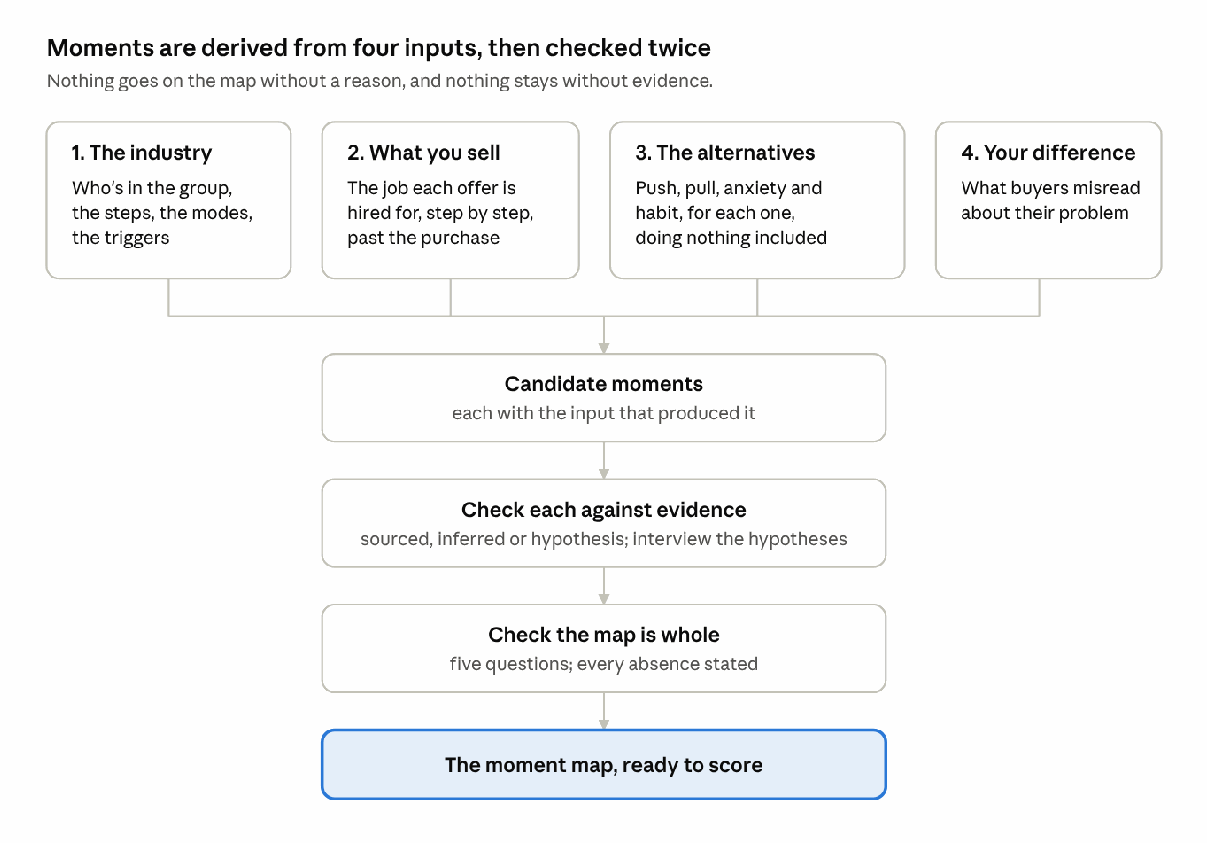
The inputs come from the steps before this one. The industry and the offer come from getting the facts and from Credentials. The alternatives and the difference come from Brand Strategy: where you play, and the reason to be chosen. The output feeds the Score in part two of this step, and then the GTM Strategy, which decides which moments to win.
Input 1: the industry gives the structure
The industry decides four things before you know anything about your own buyers: who sits in the buying group, the steps they go through, the ways they buy, and what sets them off.
Who chooses: the buying group
Research on how organisations buy has named the roles for fifty years: the people who use the purchase, influence it, decide, buy, and can block it (Webster and Wind, 1972). Later writers added the person who starts it (Bonoma, 1982). Fill each role for your category, and add the machine: an AI assistant now influences, and often gatekeeps, the shortlist. Gartner puts business buying groups at five to sixteen people across as many as four functions (Gartner, 2025).
| Role | Kestrel's chooser | Why they're on the map |
|---|---|---|
| Starts it | Chief operating officer; in investor-owned firms, the operating partner | Owns output and cost; feels the problem first |
| Uses it | Plant manager | Lives with the review on the floor |
| Influences it | Continuous improvement lead; the AI assistant | The lead's view carries weight inside; the assistant builds the first shortlist |
| Can block it | Continuous improvement lead; procurement, with site safety | The lead can treat an outside firm as a threat; procurement controls supplier approval and site access |
| Decides | Owner or managing director; finance director, for the spend | Final say, and the budget |
| Buys | Procurement | Runs the paperwork and the terms |
The roles found every chooser in Kestrel's first draft, and gave each one a reason to be there. The improvement lead had been on the map by luck; now they're there by role, as the influencer who can block.
The steps: the jobs every buying group must do
Gartner's research describes six jobs every business buying group has to get done, in no fixed order: identify the problem, explore solutions, build requirements, select a supplier, validate the choice, and build agreement inside the business. Add what comes before them (the trigger) and after them (buying, delivery, and renewal or referral), and you have the journey steps.
| Kestrel's step | The buying job behind it | In Kestrel's first draft? |
|---|---|---|
| 1. Trigger | Before the journey: the situation that starts it | Yes |
| 2. Framing | Problem identification | Yes |
| 3. Options | Solution exploration | Yes |
| 4. Requirements | Requirements building | No: added |
| 5. Comparing | Supplier selection | Yes |
| 6. Checking | Validation | No: added (it was hidden inside comparing) |
| 7. Building the case | Consensus creation | Yes |
| 8. Buying | After the jobs: contract and start | Yes |
| 9. Delivery | The job itself | Yes |
| 10. Extend and refer | Renewal, expansion and referral | Yes |
Requirements is where procurement writes the brief and the finance director sets the criteria. Checking is where buyers ring references and test claims. A brainstorm skips both, because sales rarely sees them happen.
How they buy: buy class and decision path
Robinson, Faris and Wind's buy classes (1967) say whether it's a first purchase (a new task), a changed repeat (a modified rebuy) or a straight repeat. Cross that with who decides, and Kestrel has five buying modes:
| Mode | Buy class | Who's in the room |
|---|---|---|
| Planned committee | New task | COO, finance director, plant manager, procurement; the owner signs |
| Owner-led | New task | The owner, with the plant manager |
| Investor-led | New task | Operating partner, COO, finance director |
| Urgent | New task, compressed | COO and owner |
| Repeat | Modified or straight rebuy | The next plant, the next review, or the programme renewed; often procurement alone |
The repeat mode is new. The first draft had renewal moments but no path for them.
What sets it off: category entry points
Jenni Romaniuk's category entry points are the situations that bring a category to mind. The Ehrenberg-Bass Institute finds them with seven W's: why, when, where, while, with whom, with what, and how the buyer is feeling (Oxford University Press; Ehrenberg-Bass). For a business, ask each W from two sides: the business and the professional.
| W | Kestrel's entry points | What it changes |
|---|---|---|
| Why | Flat output; rising costs; cash tied up in stock; scrap and rework; a new line below rate; after an acquisition; automation not paying back | The question. These seven become the needs, and split moments |
| When | After a bad quarter; budget season; year-end results | The timing |
| Where | One plant, or several | The scope |
| While | During a capital spending decision; during a customer audit | The timing |
| With whom | A new COO or plant manager in their first months; a new owner | The timing, and who's in the room |
| With what | A new line just installed; new automation | The question (already in "why") |
| How feeling | Pressure from a key customer; embarrassment after an audit | The tone |
This gives a rule the first draft lacked. An entry point that changes the question is a need, and splits moments. One that only changes the timing is an occasion. Occasions don't go on the moment map. They go in the campaign calendar: budget season, a new leader's first hundred days, year-end results.
Input 2: what you sell gives the needs
Every offer is hired to get a job done, and every job runs through the same eight steps: define, locate, prepare, confirm, execute, monitor, modify and conclude (Bettencourt and Ulwick, 2008). Each step raises its own questions, for someone in the buying group. Map every offer's job to the end. Most maps stop at the purchase, which is step four.
Kestrel's review is hired for one job: find and capture the savings in our plant. The improvement programme is hired for the last three steps of it: make the gains last.
| Job step | The question it raises | Whose | Where it lands | In the first draft? |
|---|---|---|---|---|
| Define | "Where's the money going: labour, scrap, stock or energy?" | Finance director | Framing | Yes |
| Locate | "What will they need from our data and our team?" | Improvement lead | Requirements | No |
| Prepare | "What do we need from them on the floor, and what can't we spare?" | Plant manager | Requirements | No |
| Prepare | "How much of my team's time will it take?" | Plant manager | Building the case | Yes |
| Prepare | "What do we need ready before they arrive?" | Plant manager | Buying | No |
| Prepare | "What data do they need from us before week one?" | Improvement lead | Buying | No |
| Confirm | "Will the numbers stand up at the board?" | Finance director | Building the case | Yes |
| Confirm | "What does an operations review cost, and what does it return?" | AI assistant | Building the case | Yes |
| Execute | "Are we on track, and what are they finding?" | COO | Delivery | Yes |
| Execute | "What do my people need to do this week?" | Plant manager | Delivery | Yes |
| Monitor | "Are the savings real, and are they being counted properly?" | Finance director | Delivery | No |
| Monitor | "Are the savings showing in the accounts?" | Finance director | Extend and refer | Yes |
| Modify | "Results are slipping. What do we do now?" | Plant manager | Extend and refer | No (the first draft asked only "did it stick?") |
| Conclude | "Will we own the methods when they leave?" | Improvement lead | Delivery | Yes |
| Conclude | "Can we run the next review ourselves?" | Improvement lead | Extend and refer | Yes |
| Conclude | "Did it pay back? Do we go into the programme?" | COO | Extend and refer | Yes |
Six of the sixteen were missing. Nearly all sit after the purchase or just before the start, where marketing rarely looks and sales has already moved on. Those are exactly the moments that decide whether Kestrel is kept, extended and recommended.
Each step holds more needs than one question. Outcome-driven research typically finds 50 to 150 separate needs for a single job (Strategyn). Don't put each one on the map. A moment is one person at one step; the needs are held inside it, as the cell's pain, gain and objections.
Input 3: the alternatives give the switching moments
Every buyer is choosing between you and something else, and doing nothing is always on the list. For each alternative, four forces decide whether they move: the push of today's situation, the pull of the new option, the anxiety about it, and the habit of the present (The Re-Wired Group). A buyer switches when push and pull outweigh anxiety and habit. Each force is a question someone in the buying group will ask, or an objection they'll raise.
Five alternatives and four forces give Kestrel twenty switching needs:
| Alternative | Push (away from it) | Pull (towards Kestrel) | Anxiety (about Kestrel) | Habit (of staying put) | Where it lands |
|---|---|---|---|---|---|
| Doing nothing | A key customer is threatening to move the contract | A fixed price and a way out make acting cheap | "What if it disrupts production?" | "We always firefight; next quarter will be better" | Owner · options; plant manager · building the case; COO · trigger |
| New equipment | The old line can't keep up | Find the capacity in the line you have, before you spend | "What if they find nothing, and we've delayed the purchase?" | The capital request is already in the budget | COO and finance director · options; owner · building the case |
| The in-house team | Lean didn't hold last time | Outside eyes for six weeks, and the team keeps the methods | "Will this make my team look bad?" | "We have people for this" | Improvement lead · framing, options, comparing, checking, building the case |
| A large firm | Day rates, long reports, and partners who vanish after the pitch | Fixed price, on the floor, and the people who pitch do the work | "Will the board trust a smaller name?" | "Nobody gets fired for hiring a big firm" | Owner · comparing and checking; finance director · comparing |
| A lean specialist | Methods, without the money case | Savings in the finance director's terms | "Are they lean consultants by another name?" | "We already know the lean playbook" | Improvement lead and finance director · framing; COO · comparing |
The forces mostly don't add cells. They fill them: every switching need becomes a cell's pain, pull or objection, in the buyer's words. That's what turns a generic cell ("comparing options") into one a writer can brief from.
Two patterns show up in almost every category. Habit is the force most plans ignore, and it's usually the strongest: the capital request already in the budget beats any argument Kestrel makes. And the anxiety about you is specific to each alternative. A buyer leaving a large firm worries about the board; a buyer leaving the in-house team worries about the team. One generic reassurance answers neither.
Input 4: the difference gives the problem insight
A real difference implies that buyers misread their problem, or misjudge the risk of fixing it. Name what they misread, and you find the moments where your reason decides the choice. Then turn it round as a test: if no moment needs a part of your difference, it isn't a difference.
| Part of Kestrel's difference | What buyers misread | The moment it decides |
|---|---|---|
| Savings are on the floor, not in new equipment (the big idea) | That flat output needs more capacity | COO · framing: "Is it people, process, equipment or planning?"; COO and finance director · options |
| Fixed price | That consulting risk is open-ended | Finance director · comparing: "Fixed price or day rates?" |
| The way out | That a review that finds little is money lost | Finance director · comparing and buying: "What if it finds nothing? How do we stop?" |
| Six weeks | That a review ties up the plant for months | Plant manager · building the case: "How much of my team's time will it take?"; COO · buying |
| On site | That reviews happen in meeting rooms | Plant manager · comparing: "On the floor, or in a meeting room?" |
| Findings in the plant manager's language | That consultants tell you what you already know, in words nobody uses | Plant manager · framing; plant manager · checking: "Can I see their people on a floor like mine?" |
Every part decides at least one moment, so every part earns its place in the reason. One of those moments wasn't in the first draft: the plant manager's checking moment, where "findings in your language" is proved by meeting the people.
The difference also tells you which framing moments to own. Kestrel wins most when it reaches the COO before they've decided the problem is capacity. After that, the capital request is in the budget and habit takes over. That's why the framing moments, and the "before you buy another line" comparison, sit at the top of every build's priority list.
Check every moment against evidence
A derived moment is still a guess until something backs it. Give every cell a source, and one of three states:
- Sourced: at least one record in the buyer's own words. A sales call, a lost deal, a tender, a client debrief, a review, a forum thread, a question put to an assistant.
- Inferred: it follows from a framework or from the offer, but nobody has said it yet. Use it, flagged.
- Hypothesis: plausible, with no record. It can't drive spending until an interview confirms it.
Kestrel's evidence (invented for the example): notes from forty sales calls over the last year, twelve lost-deal interviews, seven tenders and briefs, nine client debriefs, the question logs from the first assistant scan, competitor reviews, practitioner forums and the investor press.
| Evidence | Cells it backs | State |
|---|---|---|
| Sales call notes | 17 | Sourced |
| Lost-deal interviews | 12 | Sourced |
| Client debriefs | 8 | Sourced |
| Tenders and briefs | 7 | Sourced |
| Assistant question logs | 6 | Sourced |
| Forums (with sales calls) | 1 | Sourced |
| The job map | 5 | Inferred |
| Investor press | 3 | Inferred |
| The difference | 1 | Inferred |
| Nothing yet | 4 | Hypothesis |
51 of the 64 live cells are sourced, 9 are inferred and 4 are hypotheses. By moments, that's 136 of 149 sourced.
The gaps aren't random. The inferred cells cluster in the investor's row and in the preparation steps of the job map. The four hypotheses are the investor's requirements and checking, the improvement lead's checking, and procurement's repeat buy. So the interview plan writes itself: three operating partners, three improvement leads and two procurement leads. Keep going until new conversations stop adding needs. In one well-known study that happened within twelve interviews, with the basics clear within six (Guest, Bunce and Johnson, 2006). Treat that as a guide, not a rule: their interviewees were similar to each other, and a buying group isn't.
The evidence also corrects the words. A cell is written in the buyer's language from its best source, never in the firm's. "Operational excellence" appears in Kestrel's old brochure and in none of the forty sales calls.
Check the map is whole
Evidence checks each moment. Five questions check the map as a whole, the same way the coverage test checks a sitemap.
| Question | Kestrel's answer |
|---|---|
| 1. Was every chooser considered at every step, with any absence stated? | Yes. 80 cells considered: 64 live, 16 absent, each with a reason (below) |
| 2. Does every offer have its job mapped to the end, past the purchase? | Yes. All eight job steps for the review land in cells; monitor, modify and conclude cover the programme |
| 3. Does every alternative, doing nothing included, have its switching moments? | Yes. Twenty switching needs, five alternatives, all landed in cells |
| 4. Does every part of the difference decide at least one moment? | Yes. All six parts |
| 5. Does every stage, Known to Kept, have moments? | Yes. Kept has eleven moments across delivery and renewal, up from ten, and they now follow the job past the purchase |
Every buying mode can also be walked from start to finish: committee, owner-led, investor-led, urgent and repeat.
The sixteen absent cells, and why. A blank cell is a decision, not a gap, so each one says why it's blank:
| Chooser | Absent at | Why |
|---|---|---|
| Owner or managing director | Framing, requirements, delivery | Leaves diagnosis and scope to the COO; not involved day to day |
| Plant manager | Options | The COO and finance director weigh the options; the plant manager's concerns arrive at comparing |
| Improvement lead | Trigger | Rarely the one who starts it; often the reason it wasn't started sooner |
| Procurement | Trigger, framing, options, building the case, delivery | Joins when there's a brief to write, and leaves after the contract |
| Investor | Framing, delivery | Delegates diagnosis to the COO, and delivery to the plant |
| AI assistant | Trigger, buying, delivery, extend and refer | Not asked to start a project, sign a contract or run one; reputation checks moved to checking |
If any of those reasons turns out to be wrong in an interview, the cell goes live.
Kestrel's map, re-derived
Here is the result: ten journey steps, eight choosers, 64 live cells. Each cell holds the chooser's main question at that step. A mark shows the question changes with the problem (P), the sector (S) or the urgent mode (U). Cells marked inferred or hypothesis are waiting on evidence; new marks a cell the first draft missed.
The decision makers
| Step | Chief operating officer | Owner or managing director | Finance director | Plant manager |
|---|---|---|---|---|
| 1. Trigger | "Output's flat and a key customer is complaining. What's going on?" (P) | "Margins are slipping. Is it the plant?" (P) | "Margins fell again. What's driving the cost?" (P) | "We're always firefighting, and nobody fixes the cause." (P) |
| 2. Framing | "Is it people, process, equipment or planning?" (P) | — | "Where's the money going: labour, scrap, stock or energy?" (P) | "Will they just tell us what we already know?" |
| 3. Options | "Fix it ourselves, buy equipment or bring someone in?" (P) | "Do we need outside help at all?" | "What does each option cost, and what does it return?" (P) | — |
| 4. Requirements | "What should the review cover, and what does a good one look like?" (P) new | — | "What do we judge them on: fixed price, guarantee, references?" new | "What do we need from them on the floor, and what can't we spare?" inferred new |
| 5. Comparing | "Who does this for plants our size, in our sector?" (S) | "Can I trust them with my business and my people?" | "Fixed price or day rates? What if it finds nothing?" | "Will they work on the floor with my people, or from a meeting room?" |
| 6. Checking | "Can I talk to a plant like ours that's done this?" (S) new | "What do people I trust say about them?" new | "Who confirmed those savings, and how?" new | "Can I see their people on a floor like mine?" inferred new |
| 7. Building the case | "How do I get the finance director and the board to back this?" | "Is this the best use of the money this year?" | "Will the numbers stand up at the board?" (P) | "How much of my team's time will it take?" |
| 8. Buying | "How soon can they start, and what do they need from us?" (U) | "Who signs, and what are we committing to?" (U) | "What's in the contract, and how do we stop?" | "What do we need ready before they arrive?" inferred new |
| 9. Delivery | "Are we on track, and what are they finding?" | — | "Are the savings real, and are they being counted properly?" inferred new | "What do my people need to do this week?" |
| 10. Extend and refer | "Did it pay back? Do we go into the programme?" | "Was it worth it? Would I tell another owner?" | "Are the savings showing in the accounts?" | "Results are slipping. What do we do now?" new |
The checkers and the machine
| Step | Improvement lead | Procurement | Investor | AI assistant |
|---|---|---|---|---|
| 1. Trigger | — | — | "The value-creation plan needs margin within 18 months." | — |
| 2. Framing | "We've tried lean before. Why didn't it hold?" | — | — | "Why is my factory's output flat?" (P) |
| 3. Options | "Can we do this ourselves?" | — | "Which firms deliver operations value quickly?" inferred | "How do I improve productivity in a factory? What are the options?" (P) |
| 4. Requirements | "What will they need from our data and our team?" inferred new | "What goes in the brief, and how do we compare quotes fairly?" new | "What scope fits the 100-day plan?" hypothesis new | "What should I look for in an operations consultant?" new |
| 5. Comparing | "Will they work with us, or replace us?" | "Are they on our approved supplier list, or can they be?" | "Have they done this in portfolio companies like ours?" inferred | "Best operations consultants for mid-sized manufacturers?" (S) |
| 6. Checking | "Have they worked alongside an in-house team before?" hypothesis new | "Insurance, safety record, financial standing?" new | "Will other portfolio companies vouch for them?" hypothesis new | "Is Kestrel Advisory any good? Reviews and results?" |
| 7. Building the case | "Will this make my team look bad?" | — | "Will the board pack show the value?" inferred | "What does an operations review cost, and what does it return?" |
| 8. Buying | "What data do they need from us before week one?" inferred new | "Site inductions, payment terms and data handling?" (U) | "Can they start inside the first 100 days?" (U) | — |
| 9. Delivery | "Will we own the methods when they leave?" | — | — | — |
| 10. Extend and refer | "Can we run the next review ourselves?" | "Can we re-engage them without a new tender?" hypothesis new | "Can we use them across the portfolio?" | — |
What changed from the brainstormed draft
| Brainstormed | Derived | |
|---|---|---|
| Journey steps | 8 | 10: requirements and checking added, from the buying jobs |
| Live cells | 46 | 64 |
| Moments | 122 | 149 |
| Buying modes | 4 | 5: repeat buying added, from the buy classes |
| Cells with a stated source | 0 | 64: 51 sourced, 9 inferred, 4 hypotheses |
| Absent cells with a reason | 0 | 16 |
| Switching needs, by alternative | Scattered | 20, all landed |
| Triggers vs occasions | Mixed | Separated: occasions go to the campaign calendar |
Most of the new moments sit where nobody in sales or marketing usually looks: procurement's brief, the reference call, the week before the team arrives, and the months after the review. Those are the moments a brainstorm can't see, because nobody in the room was there.
Then score it
Part two of this step is the Selectability Score. It takes the map and asks, moment by moment, whether each of the seven stages holds: is Kestrel known, found, answered, believed, preferred, bought and kept, at this moment, for this chooser? The questions it asks of assistants and search come straight from the cells, in the buyers' words. A thin map gives a thin score. Kestrel's derived map gives the Score 149 moments to test instead of 122, including the reference call and the procurement brief, which the first draft never measured.
The Score's results then feed the GTM Strategy. Of the three tests for choosing which moments to win (worth winning, a true reason there, still open), "still open" can only be answered once the Score shows who is named today. Hypotheses are scored like any other moment but flagged, and no budget follows them until an interview confirms them.
One rule for the whole method: no moment without a reason, and no moment without a source. It's the same rule as the sitemap's, one level up.
Feeling a bit overwhelmed?
You should be, a little. That was one firm: six roles in the buying group, ten journey steps, five buying modes, sixteen job questions, twenty switching needs, six parts of a difference, sixty-four cells, each with a source, sixteen absences with reasons, and an interview plan for what's left. Every build, page and score after this depends on it.
RocMode does the heavy part for you:
- Your buyers and their moments, mapped from what you already have. RocMode reads your website, documents, profiles and records, maps your buyers across their journey, and fills each moment with its pain, gain, job to be done, objection and top question. You can change any of it, and your changes are kept.
- Their questions, asked. It turns each moment into the questions those buyers ask, and puts them to leading AI assistants, so the Score measures your moments rather than generic keywords.
- Deriving every moment from your industry, offer, alternatives and difference, with a source on each one and the completeness checks run before scoring, is what we're building next.