





Steps 6 to 9
Part Three: Plans
What the plans are for
The plans turn the map into decisions: which moments to win, what the site must hold, which builds to run, and how accounts are won and kept. They come after the Score for a reason. Until you know where buyers are lost today, and to whom, any plan is a guess about what matters.
Four plans, in order, each reading what came before it:
| Step | Plan | Decides | Reads |
|---|---|---|---|
| 6 | GTM Strategy | Which moments to win, which segments, which buying paths, and the sales motion | The moment map and the Score |
| 7 | Website Strategy | Every page, why it exists, and in what order | The map, the moments chosen, the reason, the claims |
| 8 | Marketing Strategy | Which builds lead which moments, in what order, and with what share of the effort | All of the above |
| 9 | Sales Strategy | How accounts are won, delivered, kept and grown | The motion, the moments chosen, the signed claims and cases |
Three rules hold across all four. None redefines an audience: they use the choosers and moments by name. None adds a claim: a new claim goes into Credentials first. "Moment" means one thing: a chooser at a step. A trade show or budget season is an occasion, and goes in the campaign calendar.
Kestrel is the worked example throughout: its strategy is in Part one, and its 149 moments in Where you stand.
6. GTM Strategy: which moments to win, and how to sell
In RocMode, the GTM Strategy holds the ideal customer, the segments, the win strategy, the sales motion, the messaging with its sales enablement, and how leads are covered and routed. Here it starts from the map and the Score, and makes four decisions.
Which moments to win first
Every moment worth winning gets covered; the GTM Strategy decides the order. Three tests sort them: worth winning (does it lead to work Kestrel wants?), a true reason there (does a signed claim decide it?) and still open (does the Score show nobody owns it yet?).
| Tier | Kestrel's moments | Why |
|---|---|---|
| Win first | Flat output and rising costs, at the trigger, framing and options steps, for the COO, the finance director and the assistant; every comparing and checking moment by sector; the finance director's price and way-out questions; "before you buy another line" | Most of Kestrel's work starts here; the big idea and the way out decide them; the Score shows assistants name no one consistently |
| Win next | The other five problems; the investor's path; the improvement lead's moments; procurement's brief | Worth winning, with a reason there, but smaller or slower |
| Hold | The four hypotheses: the investor's scope and checking, the improvement lead's checking, procurement's repeat buy | Scored and watched, but no spend until interviews confirm them |
Which segments
Mid-sized manufacturers with flat output or rising costs, in the four sectors, first. Investor-owned manufacturers second: fewer of them, but each brings a portfolio, which is why the repeat path matters.
Which buying paths
All five modes stay on the map, but the motion is built for two first: the planned committee, where most of Kestrel's work comes from, and the urgent path, where speed decides. The owner-led and investor-led paths reuse the committee's assets with a different order. The repeat path is run by Sales.
The motion and the win strategy
The sales motion is sales-led and consultative, and it's set by the firm, never guessed: a fit call, a one-page scope, a proposal the committee can forward, a reference call, the business case, the contract, week zero, the review, then the programme or the next plant.
The win strategy names how Kestrel wins against each alternative, using the switching forces from the map: against new equipment, find the capacity in the line first; against a large firm, the people who pitch do the work, at a fixed price; against the in-house team, they lead and keep the methods; against doing nothing, the way out makes acting cheap.
7. Website Strategy: what the site must hold
The website is the only build lit in every live cell: whatever a buyer hears elsewhere, they check on the site. So its plan comes first, and it's worked through in full in the Website Playbook. In RocMode, the website strategy has nine sections, from the site's thesis to its page inventory, and checks every page for the moments it covers.
For Kestrel, the result is 47 pages, plus one per case study, each traced to the moments it answers. The site leads 31 of the 149 moments and supports the other 118. Twelve pages are P1 and launch first; the rest follow in two waves.
8. Marketing Strategy: which builds, in what order
In RocMode, the marketing strategy has eight sections, from the growth thesis through channels, content pillars, campaign concepts, measures and budget to the roadmap. Campaigns are its delivery plan, not a separate strategy. Its central decision is which build leads each moment.
Six categories, fourteen builds
Every way a buyer meets a brand sits in one of six categories, sorted by one question: who is speaking, and how did they reach the buyer? It extends Gini Dietrich's PESO model (paid, earned, shared, owned), which was built for communications. Shared becomes partnered, and two are added: direct, because for most firms a person in a room decides more moments than any channel; and relationship, because the system that remembers a customer decides whether they stay.
| Category | Who is speaking, and how | Builds | Nods |
|---|---|---|---|
| Owned | Your voice, on ground you own | Website; Content; Social | Packaging and physical |
| Paid | Your voice, in space you buy | Advertising | Sponsorship; retail media; broadcast and outdoor; direct mail |
| Earned | Someone else's voice, freely given, including AI answers | Being named: search and AI answers; PR and reviews | Analyst relations; awards; word of mouth |
| Partnered | Someone else's voice or audience, by agreement | Partners and channels; Creators | Affiliates; marketplaces; associations; employee advocacy |
| Direct | A person, live | Outbound and account-based; The pitch; Events | Account management; customer service |
| Relationship | Your system, to someone you already know | Email; Automation; Customers: onboarding, loyalty, community and referral | CRM; SMS and chat |
A channel earns its own build only if it has its own shape, its own craft, and moments it leads better than anything else. The rest get a nod: a short section in the nearest build's playbook. Formats such as video, podcasts and webinars live inside builds, not beside them. Offer, price, product and distribution aren't builds at all: they're foundations, set in the strategy.
Fourteen builds, fourteen footprints
A build's footprint is the moment map with that build's cells lit. It's worked out, not chosen. Two rules keep it true:
1. A cell lights up only where the build is the best answer to the moment, or where
- buyers expect to find one. That a build could touch the moment isn't enough.
2. Each cell has one lead build, and any number of supporting builds. The lead does the
- work at that moment. The supporters echo the same message.
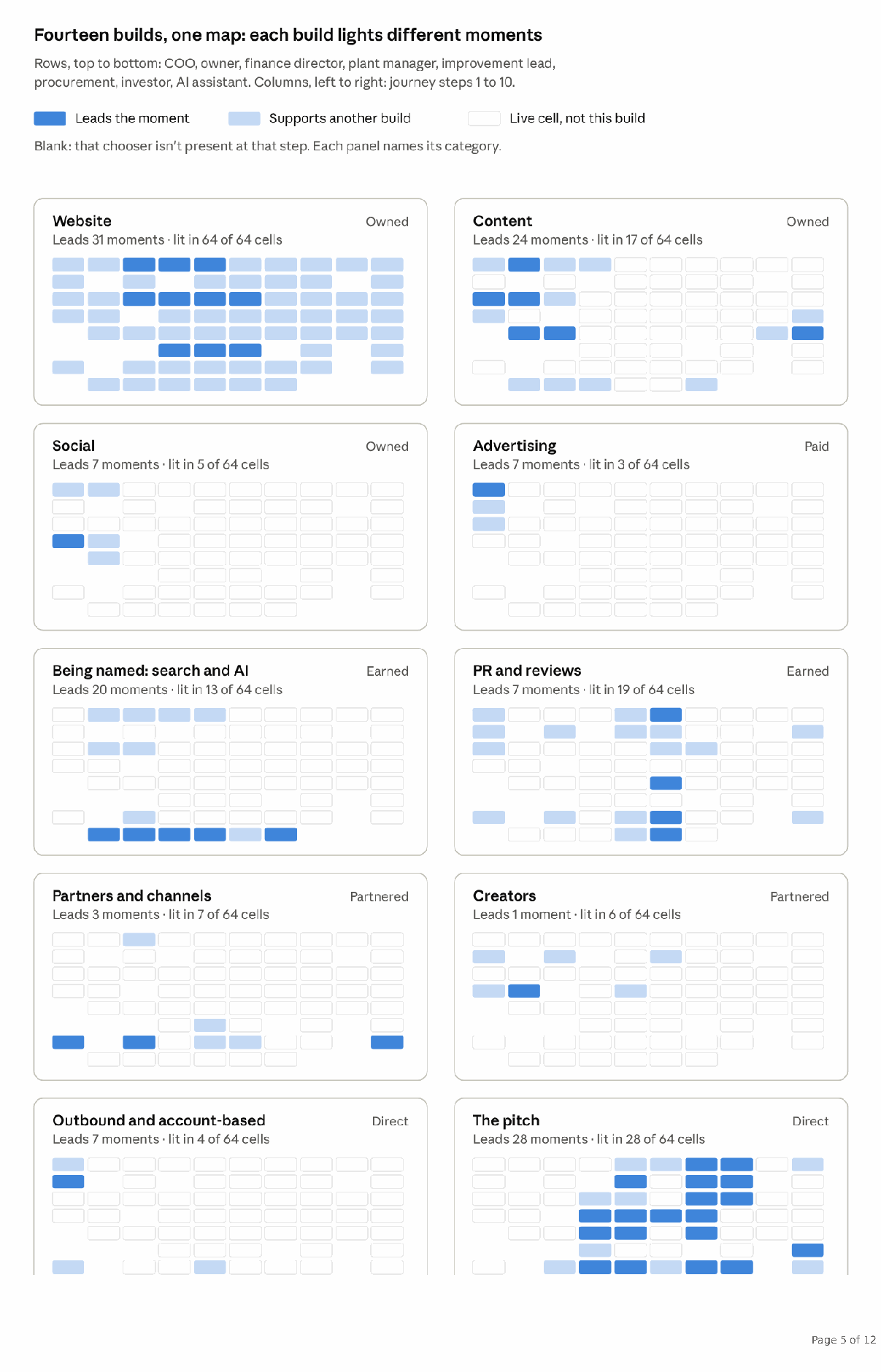
| Build | Category | Leads | Supports | Where it leads |
|---|---|---|---|---|
| Website | Owned | 10 cells, 31 moments | 54 cells | The COO's and finance director's options, scope and comparing; the finance director's checking; procurement's brief, comparing and checking |
| Content | Owned | 6 cells, 24 moments | 11 cells | The finance director's trigger; framing for the COO, finance director and improvement lead; the improvement lead's options and next review |
| Social | Owned | 1 cell, 7 moments | 4 cells | The plant manager's trigger |
| Advertising | Paid | 1 cell, 7 moments | 2 cells | The COO's trigger, for each of the seven problems |
| Being named: search and AI | Earned | 5 cells, 20 moments | 8 cells | Every assistant question before the pitch: framing, options, scope, comparing, cost and return |
| PR and reviews | Earned | 4 cells, 7 moments | 15 cells | The reference and reputation checks for the COO, improvement lead and investor, and what assistants say when a buyer checks |
| Partners and channels | Partnered | 3 cells, 3 moments | 4 cells | The investor's trigger, options and portfolio follow-on, reached through the advisers and lenders investors already use |
| Creators | Partnered | 1 cell, 1 moment | 5 cells | The plant manager's framing |
| Outbound and account-based | Direct | 1 cell, 7 moments | 3 cells | The owner's trigger: named firms, one problem at a time |
| The pitch | Direct | 19 cells, 28 moments | 9 cells | Building the case and buying for almost everyone; the plant manager's, improvement lead's and investor's scope; comparing for the owner, plant manager, improvement lead and investor; the plant manager's site visit; procurement's renewal |
| Events | Direct | 2 cells, 2 moments | 3 cells | The owner's options and checking: round tables where owners hear from owners |
| Relationship | 3 cells, 3 moments | 14 cells | Delivery for the COO and finance director; the finance director's follow-on | |
| Automation | Relationship | 4 cells, 5 moments | 9 cells | Procurement's paperwork; the week-zero preparation for the plant manager and improvement lead; the plant manager's week-by-week needs |
| Customers | Relationship | 4 cells, 4 moments | 4 cells | The improvement lead's handover; the follow-on for the COO, owner and plant manager: the results review, the client community and the referral |
The leads add up to 64 cells and 149 moments: every moment has exactly one lead.
What Kestrel's footprints show: the website is the hub, lit everywhere but leading only a fifth of the moments; the pitch leads the most cells, because a committee builds its case and buys in meetings, not on a screen; PR and reviews support far more than they lead, because a reference or a review backs almost every claim made elsewhere; the four newer builds each lead a few moments nothing else wins as well: events for owners, partners for investors, outbound for named firms, and customers after the work is done; and advertising, social and creators lead very little. That's right for a consultancy sold to committees. A consumer brand's footprints would look almost reversed. Footprints are worked out for each firm, never copied from a template.
The check across all fourteen builds
- No moment without a lead. Every one of the 149 moments has exactly one lead build.
- No build without a lead. Every build leads at least one moment. A build that only supports is a cost without a job. For Kestrel, creators come closest, with one.
- One message per crowded cell. The COO's trigger is the most crowded: advertising leads, and social, PR, content, the website, events and outbound support. All seven say the problem in the buyer's words and give the same reason.
- Hand-offs, not dead ends. The ad sends the COO to a problem page; the page offers the business case kit; the kit leads to the pitch; the pitch offers a reference call; the reference call is arranged by PR and reviews; the results review, run by Customers, asks for the next plant and the referral.
In what order
The order follows the GTM tiers and what each build needs from the others. For Kestrel's first year:
| Quarter | Builds | Why then |
|---|---|---|
| One | Website wave 1; being named (the facts fixed everywhere, the sector sentence); the pitch kit | Everything else sends buyers to the site and the pitch; wrong facts get repeated until they're fixed |
| Two | Content P1 guides and the benchmark; PR and reviews (references, first reviews); email for delivery and renewal; customers (handover and the results review) | The framing moments and the checking step, once there's a site to land on; every current client becomes a reference |
| Three | Website wave 2; advertising for the COO's trigger; social; creators; outbound to named firms; partners and channels for investors | Paid, outbound and partner attention only once the pages and proof can hold it |
| Four | Website wave 3; events (the first owners' round table); automation; the rest of the content plan | Events need clients willing to speak; the routines keep the rest running |
9. Sales Strategy: how accounts are won and kept
In RocMode, the sales strategy lives in the GTM record: the win strategy, the messaging with its sales enablement (objections with proof, assets, kits for each person in the buying group), and how leads are covered and routed. Here it covers the whole account, from the first call to the referral, because no other plan owns what happens after the signature.
The motion, step by step
| Motion step | The moments it serves | What Kestrel brings |
|---|---|---|
| Fit call | COO · comparing and buying; owner · comparing | Who it's for and who it isn't for; the six weeks; the price range |
| One-page scope | COO, plant manager, improvement lead and investor · scope | What the review covers in this plant, what it needs from the team, what it won't touch |
| Committee proposal | Everyone · building the case | One page per person in the room, each answering their own question; forwardable without the pitch |
| Reference call | COO, owner, improvement lead and investor · checking | A client in the same sector, arranged within a week |
| Business case | COO and finance director · building the case | The kit, filled in with their numbers; the way out stated |
| Contract | Finance director, owner and procurement · buying | Terms that match the website word for word |
| Week zero | Plant manager and improvement lead · buying | The preparation checklist and the data request, sent automatically |
| The review | COO, plant manager and improvement lead · delivery | Weekly findings in the plant manager's words |
| Results and renewal | COO, finance director, plant manager and procurement · extend | Savings confirmed with the client's finance team; the programme or the next plant; re-engagement without a new tender |
| Referral | Owner and investor · extend | A reference the client is glad to give; the portfolio conversation |
Objections, each with its proof
| Chooser | The objection | The proof that answers it |
|---|---|---|
| Finance director | "Consultants always overstate savings." | Savings confirmed by clients' finance directors, months later; the way out |
| Owner | "Will the board trust a smaller name?" | References from owners of similar firms; the people who'll be on site |
| Plant manager | "They'll tell us what we already know." | A sample review report, in plant language; a visit to a floor like theirs |
| Improvement lead | "This is a verdict on my work." | Cases where the in-house team led the changes and kept the methods |
| COO | "We were about to buy a new line." | The capacity found in lines like theirs, before the purchase |
| Procurement | "We can't compare a fixed price with day rates." | A brief template with the criteria that matter, and the terms in writing |
| Investor | "Can they move inside our hundred days?" | Start dates and portfolio cases |
Every proof must be a signed claim in Credentials. If an objection has no signed proof, that's a gap in Credentials, not a sales problem.
Routing by buying path
- Planned committee: the full motion, with a proposal page for each person.
- Owner-led: fit call, a site visit and the contract, often in two meetings; references from other owners first.
- Investor-led: the operating partner first; the business case doubles as the board pack.
- Urgent: fit call to contract in days; the start date and week zero lead.
- Repeat: the account owner, not a new sale; procurement re-engages without a tender where the contract allows it.
What comes next
The plans say what to do. Part four does it: the fourteen build playbooks, each starting from its footprint (the website, being named, content, the pitch, email, automation, PR and reviews, customers, partners and channels, events, outbound, advertising, social and creators), with the nods inside them; then the Campaign Engine, which turns the builds into twelve months of campaigns around moments and occasions; then the Loop, which rescores and changes the plan when the numbers move.
Feeling a bit overwhelmed?
You should be, a little. Four plans: three tiers of moments, two segments, five buying paths, a sales motion in ten steps, seven objections each with signed proof, 47 pages, fourteen footprints in six categories that must agree on 149 moments, and a year's build order. Most firms write the marketing plan, the website brief and the sales playbook separately, in different years, by different people. That's how a website ends up selling one firm and a pitch another.
RocMode does the heavy part for you:
- Your GTM strategy. Your ideal customer, segments, win strategy, sales motion, messaging and how leads are covered and routed, all read from your strategy and your buyers' moments.
- Your website and marketing strategy. A website strategy with a reason for every page, and a marketing strategy from the growth thesis to the roadmap, with campaign concepts that become campaigns.
- Your sales strategy. Objections with their proof, kits for each person in the buying group, and routing, from the same moments as everything else.