





Owned
The Content Playbook
The idea
Content earns its place by answering a question a buyer actually has, before anyone is selling to them. Most content plans start from a calendar: two posts a week, a webinar a quarter, an ebook for the funnel. Then they hunt for topics to fill the slots. That gives volume, and buyers learn to ignore it.
This playbook starts from the other end. The coverage unit is one piece per unanswered question. Every question comes from a moment in the grid. Every piece answers a set of questions for named choosers, and the calendar is whatever it takes to write them.
Three things follow:
- Fewer, deeper pieces. One guide that fully answers ten related questions beats ten posts that each half-answer one.
- Every piece feeds other builds. A problem guide becomes the website's problem page, the passages assistants quote, the newsletter issue, the social posts and the ad's landing page. Content is the raw material; the other builds are its outlets.
- The calendar comes last. First decide what must exist. Then decide the order. Then set the rhythm the team can keep.
The footprint, and Kestrel in 60 seconds
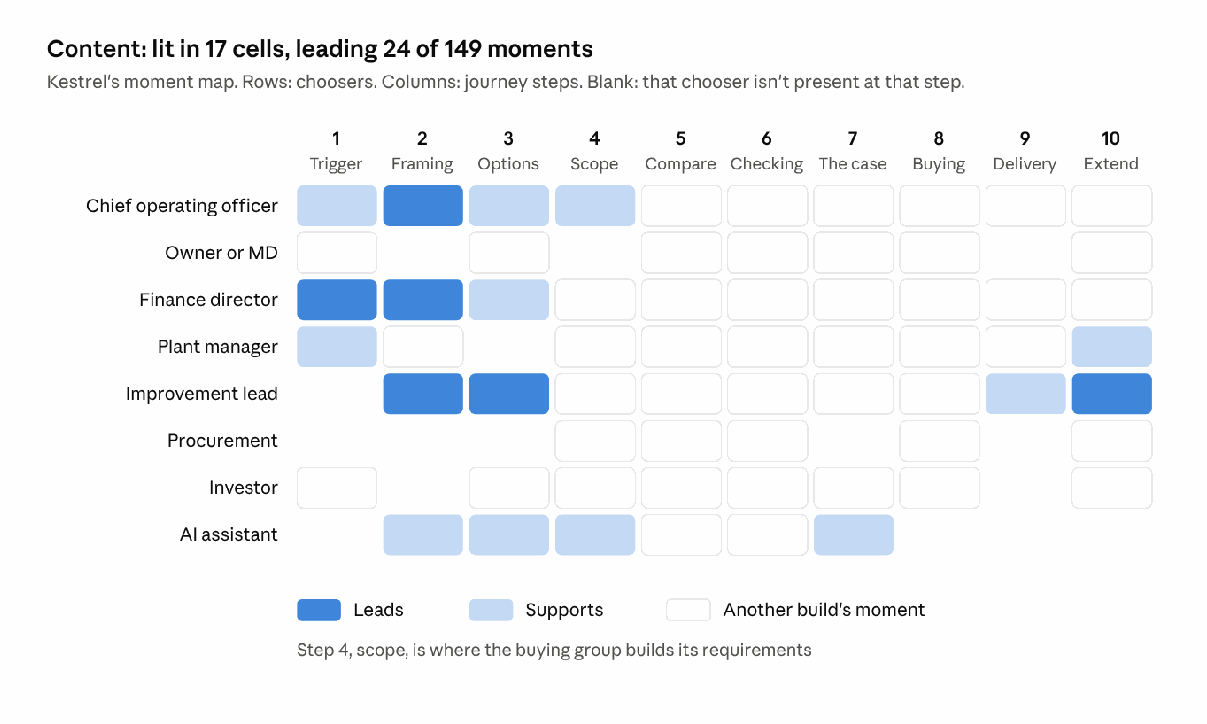
Content leads where buyers are still working out what's wrong: the COO's and finance director's framing, the finance director's first alarm about costs, and almost everything the in-house improvement lead asks. It supports the early moments other builds lead (the ad, the social post, the assistant's answer, the website's options pages) and two of the questions that come after the review.
Kestrel in 60 seconds. Kestrel Advisory is the invented firm used in every playbook: a 60-person operations consultancy that helps mid-sized manufacturers find waste and lift output. Its main offer is a fixed-price, six-week operations review. Its strategy is in Part one, and its full moment map in Where you stand, part one.
- Who chooses: usually a committee. The COO starts it, the finance director approves the spend, the plant manager lives with it and procurement runs the paperwork. The owner, the in-house improvement lead, an investor and AI assistants all have a say.
- The reason to be chosen: "We find the savings on the floor in six weeks, at a fixed price, and the review pays for itself or you don't proceed." (Invented. A real firm would need proof for every part of that sentence.)
- The alternatives: a large consulting firm, a specialist lean consultant, the in-house improvement team, buying new equipment, or doing nothing.
Its slice of the Score
Content's part of the Selectability Score is the early gate and the first answer: Known and Found at trigger and framing, and Answered wherever a buyer is still working out what's wrong.
| Kestrel today, at the 23 moments content leads before a deal | Known | Found | Answered | Moment score |
|---|---|---|---|---|
| Average | 10 | 0.7 | 5 | 0.1 |
One detail in those numbers is worth more than the averages. The only two moments where search finds Kestrel at all are both content: two old blog posts, on flat output and rising costs, that still rank on page one. They were written years ago, they answer part of a real question, and they still work. Twelve posts, two of them still ranking, and those two are the whole of Kestrel's presence before a buyer calls. That's the case for this build in one line: content that answers a buyer's question keeps working; content that fills a slot doesn't.
Step 1: the shape, pillars and formats
Content has two kinds of shape: the pillars (what the firm is known for talking about) and the formats buyers in the category expect.
The pillars come from the story spine. Kestrel's spine is: the problem in the buyer's words, the reason, the proof pattern and the way out. So its pillars are:
| Pillar | What it's for | The spine it carries |
|---|---|---|
| The problems | Why output is flat, costs climb, stock piles up, and what to check first | The problem, in the buyer's words |
| The cost | What each problem costs, in money a finance director can use | The reason: savings found on the floor |
| The evidence | What reviews find, across plants, sectors and sizes | The proof pattern |
| Making change stick | Why improvements fade, and how in-house teams keep them | The way out, and what clients keep |
Nothing goes outside the four. "The future of manufacturing" isn't a pillar; it's a slot-filler.
The formats come from the category. Count what the leading competitors publish. A format on at least three of five sites is canon: buyers expect to find it, and its absence costs belief.
| Format | Competitors using it (of 5) | Canon? |
|---|---|---|
| Long-form guides | 5 | Yes |
| Articles | 5 | Yes |
| Case stories | 5 | Yes (built in the Website Playbook) |
| Research reports | 4 | Yes |
| Newsletters | 3 | Yes (run in the Email Playbook) |
| Webinars | 3 | Yes |
| Templates and checklists | 2 | No |
| Video | 2 | No |
| Podcasts | 1 | No |
The counts are invented for the example. Canon tells you what's expected, not what's enough: a format only earns a piece when a question needs it.
Step 2: coverage, the question bank
Start from the footprint: 17 lit cells, split by problem where the question changes. That's 77 moments: 24 that content leads and 53 it supports.
A moment content leads holds more than its top question. The cell's pain, cost and objection each raise a question of their own, so lead moments get four. For the COO's framing moment on flat output:
1. The top question: "Is it people, process, equipment or planning?"
2. What's causing it: "Why does output stay flat when we're running flat out?"
3. What it costs: "What is the lost output worth to us each month?"
4. What to do first: "What should we check this week, before we spend anything?"
Supporting moments get one question each: the content that helps the lead build do its job.
| Cell | This build | Moments | Questions each | Questions |
|---|---|---|---|---|
| COO · framing | Leads | 7, one per problem | 4 | 28 |
| Finance director · trigger | Leads | 7 | 4 | 28 |
| Finance director · framing | Leads | 7 | 4 | 28 |
| Improvement lead · framing: "Why didn't lean hold?" | Leads | 1 | 4 | 4 |
| Improvement lead · options: "Can we do this ourselves?" | Leads | 1 | 4 | 4 |
| Improvement lead · extend: "Can we run the next review ourselves?" | Leads | 1 | 4 | 4 |
| COO · trigger | Supports advertising | 7 | 1 | 7 |
| Plant manager · trigger | Supports social | 7 | 1 | 7 |
| COO · options | Supports the website | 7 | 1 | 7 |
| Finance director · options | Supports the website | 7 | 1 | 7 |
| Assistant · framing | Supports search and AI answers | 7 | 1 | 7 |
| Assistant · options | Supports search and AI answers | 7 | 1 | 7 |
| Assistant · building the case | Supports search and AI answers | 1 | 1 | 1 |
| Improvement lead · delivery | Supports customers | 1 | 1 | 1 |
| Plant manager · extend | Supports customers | 1 | 1 | 1 |
| COO · scope: "What should the review cover?" | Supports the website | 7 | 1 | 7 |
| Assistant · scope: "What should I look for in an operations consultant?" | Supports being named | 1 | 1 | 1 |
149 questions. That's the bank. Each one is written in the buyer's words, tagged with its cell, its problem, its stage and its bias, and kept in one list the whole team can see. A writer never starts from a topic. They start from a set of questions, and the piece is finished when every one is answered.
Step 3: what's answered today, then gaps, biases and jobs
Audit what exists against the bank. Kestrel's old blog (invented) had twelve posts. Five answer no question in the bank at all: company news, two event write-ups, an award and "the future of manufacturing". The other seven touch 14 questions in passing. None of the 149 questions is answered fully.
| Pillar | Questions | Touched today | The stage that fails | The bias at work |
|---|---|---|---|---|
| The problems | 77 | 9, by posts on equipment effectiveness, scheduling and changeovers | Known: nothing in the buyer's words; Found: posts too thin to quote | Familiar feels safe: buyers read the names they already know |
| The cost | 56 | 2 | Believed: no figures a finance director could use | Losses loom larger: without a cost, doing nothing feels safe |
| The evidence | 1 | 0 | Believed: nothing across reviews | We follow others |
| Making change stick | 15 | 3, by one post on lean | Preferred: nothing for the improvement lead, who reads Kestrel as a threat | Losses loom larger |
Each gap becomes a job:
| Moment | Stage | Bias | The job |
|---|---|---|---|
| COO · framing, each problem | Known | Familiar feels safe | One guide per problem, in the COO's words, that names the likely causes and what to check first |
| COO · framing | Answered | A hard choice stalls | End each guide with the options, including fixing it in-house and buying equipment, and when each is right |
| Finance director · trigger, each problem | Known | Losses loom larger | Put a cost on each problem, in money and in a form a finance director can test with their own numbers |
| Finance director · framing | Believed | We follow others | Back every cost with sourced figures from the benchmark, never estimates dressed as facts |
| Assistant · framing and options | Found | Good enough beats best | Write each guide in passages that answer one question each, so assistants can quote them |
| Improvement lead · framing | Preferred | Losses loom larger | Explain why improvement programmes fade without blaming the people who ran them |
| Improvement lead · options | Believed | Familiar feels safe | Publish how to run a review in-house: candid, useful, and the best proof that Kestrel isn't a threat |
| Improvement lead · extend | Kept | We follow others | Show how client teams run the next review themselves |
| Plant manager · extend | Kept | Losses loom larger | A 90-day check that the changes stuck, which plant managers can run alone |
| Everyone · evidence | Believed | We follow others | An annual benchmark from Kestrel's reviews, published with clients' permission |
The in-house guide will look risky to some. Giving away the method seems to give away the sale. It doesn't. The improvement lead was going to block Kestrel anyway; the guide turns a blocker into a reader. And a team that tries it alone and gets stuck knows exactly who to call.
Step 4: reconcile, the content plan
Put the questions into the pillars, and choose the format each set of questions needs. Group questions that one reader would want answered together. Kestrel's 149 questions fall into 19 core pieces. This is the content build's equivalent of a sitemap.
| Piece | Pillar | Format | Questions | Signals | Priority |
|---|---|---|---|---|---|
| When output is flat: causes, costs, what to check first, and what a review should cover | The problems | Long-form guide | 11 | Canon, coverage, strategy | P1 |
| When costs keep rising | The problems | Long-form guide | 11 | Canon, coverage, strategy | P1 |
| When cash is tied up in stock | The problems | Long-form guide | 11 | Canon, coverage | P2 |
| When scrap and rework climb | The problems | Long-form guide | 11 | Canon, coverage | P2 |
| When a new line won't reach speed | The problems | Long-form guide | 11 | Canon, coverage | P2 |
| After an acquisition: where the operating margin hides | The problems | Long-form guide | 11 | Canon, coverage | P2 |
| When automation isn't paying back | The problems | Long-form guide | 11 | Canon, coverage | P2 |
| What flat output really costs | The cost | Article | 8 | Canon, coverage, strategy | P1 |
| What rising costs are made of | The cost | Article | 8 | Canon, coverage, strategy | P1 |
| What stock really costs | The cost | Article | 8 | Canon, coverage | P2 |
| What scrap and rework really cost | The cost | Article | 8 | Canon, coverage | P2 |
| What a slow ramp-up costs | The cost | Article | 8 | Canon, coverage | P2 |
| What margin an acquisition can find on the floor | The cost | Article | 8 | Canon, coverage | P2 |
| What idle automation costs | The cost | Article | 8 | Canon, coverage | P2 |
| The mid-sized manufacturing operations benchmark (annual) | The evidence | Research report | 1, and feeds every guide | Canon, coverage, strategy | P1 |
| How to run an operations review in-house, and what a good one covers | Making change stick | Long-form guide | 5 | Canon, coverage, strategy | P1 |
| Why improvement programmes fade | Making change stick | Article | 4 | Canon, coverage | P2 |
| Running the next review yourselves | Making change stick | Article | 5 | Canon, coverage | P2 |
| The 90-day check: did the changes stick? | Making change stick | Checklist | 1 | Coverage | P3 |
The questions add up to 149. Every piece traces back to named cells; every question has a piece.
Families. The seven problem guides share one template and one brief, filled in per problem. So do the seven cost articles. That's 14 of the 19 pieces from two templates, which is how a small team keeps them consistent.
One piece, many outlets. Each core piece is written once and used by the other builds. This is where content pays for itself:
| Core piece | What it becomes | Assets |
|---|---|---|
| Each problem guide (7) | The website's problem page; a newsletter issue; four social posts; a one-page checklist | 49 |
| Each cost article (7) | A section of the finance director's page; a newsletter issue; two social posts; an ad for the COO's trigger moment | 35 |
| The benchmark report | A press release; seven problem cuts; four sector cuts; a webinar; ten social posts | 24 |
| The four improvement-lead pieces | A newsletter issue and two social posts each | 12 |
19 pieces become 120 assets. The webinar finally earns its place: it presents the benchmark, rather than filling a quarterly slot.
Build order. Priority sets the order, never the list. Six P1 pieces first, then twelve P2, then one P3. At two core pieces a month, that's about ten months for one writer, with the benchmark refreshed each year.
Rejected, with reasons:
- "The future of manufacturing" and other opinion pieces. No moment asks for them. They fill a calendar, not a buyer's need.
- News, events and awards as articles. They answer no question in the bank. If they're worth sharing, they go in the newsletter or on social.
- A weekly posting quota. Volume set before questions is how the old blog ended up with twelve posts that answered nothing.
- Gating the guides behind a form. Assistants can't read behind a form, so a gated guide can't be quoted. The guides stay open. Only the benchmark's detailed data is gated, for buyers who want it.
- 28 sector-by-problem articles. The questions don't change enough. Sector examples go inside each guide instead.
- Mass-produced articles. Thin pieces dilute the ones that do the work, and contradict the proof pattern.
The coverage test: every one of the 149 questions has a piece; every piece answers named questions; every lead moment is answered in full by at least one piece; and every piece has at least one outlet in another build.
The anatomy library
Each kind of piece has a standard order of sections. Readers know where to look, and assistants find each answer where they expect it. Required sections are in bold.
| Piece | Kestrel's pieces | Sections, in order | Length |
|---|---|---|---|
| Problem guide | 7 | The problem in the buyer's words, answered in one paragraph · The likely causes, ranked · What it costs · What to check this week · The options, including doing nothing · What a good review covers · A case · Related questions · One next step | 2,500 to 3,500 words |
| Cost article | 7 | The cost, in one sentence, with its source · How it's made up · Work out your own · What usually moves it · One next step | 900 to 1,400 words |
| Research report | 1 | The headline findings · Method and sample · Findings by problem · Findings by sector and size · What the best plants do differently · Sources and permissions | 20 to 30 pages; a 2-page summary open to all |
| Method guide (in-house) | 1 | What you'll be able to do · The steps, in order · The templates · Where teams get stuck · When to call for help | 3,000 to 4,000 words |
| Practice article | 2 | The answer first · Why it happens · What works, with an example · One next step | 1,000 to 1,500 words |
| Checklist | 1 | What it checks, and when to use it · The checks · What to do with the result | One page |
Three rules hold for every piece:
- Every section answers one question from the bank, and answers it in its first sentence.
- Every figure carries its source in the same sentence, and comes from the benchmark, a named case or a cited study.
- Every piece ends with one next step, chosen for the reader's moment: the checklist after a guide, the business case kit after a cost article.
Step 5: the piece brief, then a brief for every section
The piece brief holds what no single section can: the questions, who they're for, the pillar, the arc from the first question to the next step, and where the piece will be used. Then every section gets its own brief, answering one question for one chooser.
PIECE When output is flat: causes, costs and what to check first (long-form
guide)
PILLAR The problems
QUESTIONS (11) COO framing x4: "Is it people, process, equipment or
planning?", "Why does output stay flat when we're running flat out?", "What
is the lost output worth each month?", "What should we check this week?"; COO
trigger; plant manager trigger; COO options; COO scope: "What should the
review cover?"; finance director options; assistant framing; assistant
options
READERS COO first; plant manager; finance director skims the cost section;
assistants quote the passages
THE ARC Recognise the problem in your own words, see the likely causes, put
a number on it, check three things this week, see your options, take one
small next step
THE REASON (echo, never sell) Savings are usually found on the floor, not in
new equipment
PROOF Benchmark figures for flat-output plants, sourced and dated; one named
plant
NEXT STEP The checklist; then the business case kit for readers who want to
act
OUTLETS Website problem page; 10 quotable passages; newsletter issue; four
social posts; checklist
GUARD Every figure from the benchmark or a named case; no claim Kestrel
couldn't defend to a plant manager
Then each section gets its own brief. Two of the seven:
SECTION 2 Why output stays flat when you're running flat out
ANSWERS COO: "Why does output stay flat when we're running flat out?"
JOB Known · COO · familiar feels safe (name the causes they half-suspect, in
their words)
FIRST SENTENCE The answer: the usual causes, most likely first
THEN Three causes, each with how it shows up on the floor and a benchmark
figure
PASSAGES Each cause stands alone in under 80 words, so an assistant can
quote it
GUARD No cause blamed on the plant's people; every figure sourced
SECTION 6 Your options: fix it in-house, buy equipment or bring someone in
ANSWERS COO and finance director: "Fix it ourselves, buy equipment or bring
someone in?"
JOB Answered · COO and finance director · a hard choice stalls (make the
choice simple, and fair)
FIRST SENTENCE When each option is right, in one line each
THEN What each costs and how long it takes; when buying equipment is the
right answer
LINKS Kestrel compared; Kestrel vs new equipment; How to run an operations
review in-house
GUARD Fair to every option, including the ones that don't need Kestrel
The flow check. Read the finished guide top to bottom against the arc. Then read each passage alone, as an assistant would quote it. A guide has to work both ways.
The finished example: "What flat output really costs", written in full
The cost article is the finance director's piece: it leads the finance director's trigger on flat output, and supports the COO's ad and the website's finance director page. It answers eight questions from the bank. Each section carries its job in italics, then the copy. Kestrel, its benchmark and its clients are invented.
Headline: What flat output really costs a mid-sized plant
The cost, in one sentence
Known · finance director · losses loom larger
In a mid-sized plant, flat output usually costs between 4% and 9% of annual contribution margin, almost all of it from capacity the plant already owns but doesn't use (Kestrel operations benchmark 2025, 38 plant reviews).
How it's made up
Answered · finance director · a hard choice stalls
The cost doesn't show up as a line in the accounts. It hides in three places:
- Lost sales and late penalties. Orders turned away or shipped late because the bottleneck line can't keep up. In the benchmark, 21 of the 38 plants had paid late-delivery penalties in the year before their review.
- Overtime and weekend shifts to make up for capacity lost during the week. The median plant ran 9% of its labour hours as overtime (benchmark).
- Capital spent too early. A new line bought to add capacity the old one was losing. Six of the 38 plants had a purchase approved or under way when their review started.
Work out your own
Believed · finance director · we follow others
You don't need our figures. Use yours:
Lost hours a week = (best rate - average rate) / best rate x running hours
Contribution lost = lost hours x units per hour at best rate x contribution
per unit
A worked example. A carton line runs 120 hours a week. Its best sustained rate is 47 cartons a minute; its average is 41. That's 13% of its time lost: about 15 hours a week. At 2,820 cartons an hour and 9 cents' contribution a carton, that's about A$3,900 a week, or A$200,000 a year, from one line. If the line is the bottleneck, every carton it doesn't make is one the plant doesn't sell.
What usually moves it
Answered · finance director and COO · good enough beats best
In the benchmark, three changes recovered most of the lost capacity: changeovers timed and owned (the largest gain in 23 of the 38 plants), small stops logged and fixed at the root, and the bottleneck line loaded first in the schedule. None needed capital. In the plants that made all three, the median gain was 11% more output from the same line within three months.
One next step
Bought · finance director · a hard choice stalls
If your number from the worked example is larger than you expected, the business case kit puts it in a form the board will accept, with the assumptions shown. [Build the case →]
What to notice. Every figure carries its source in its sentence, so an assistant can quote any one of them correctly. The worked example lets a finance director trust the method without trusting Kestrel. And the piece sells nothing until its last line, which is why a finance director forwards it, and why it can feed the ad, the finance director's page, a newsletter issue and two social posts without being rewritten.
Templates
The question bank (one row per question; the team's single list)
| ID | Question, in the buyer's words | Moment (chooser · step · need) | Lead or support | Stage | Bias | Pillar | Piece that answers it | Answered in full? |
|---|---|---|---|---|---|---|---|---|
The piece brief
PIECE [title, as the buyer would search it]
TYPE [from the anatomy library] PILLAR [one of the pillars]
QUESTIONS [the bank IDs it must answer in full]
READERS [choosers and moments]
THE ARC [first question to one next step, in one line]
FIGURES [each one, with its source]
CLAIMS USED [from the claims register, with state]
OUTLETS [which builds use it, and as what]
PRIORITY [P1-P3] FRESHNESS [evergreen / refresh yearly / dated]
The section brief
SECTION [name]
THE QUESTION [bank ID, answered in the first sentence]
JOB [stage · chooser and moment · bias]
FIGURE + SOURCE [in the same sentence]
WORDS [target]
GUARD [passes only if it reads correctly on its own]
The outlet map (one row per core piece)
| Core piece | Website page | Passages for being named | Newsletter issue | Social posts | Ad or landing page | Sales asset | Live? |
|---|---|---|---|---|---|---|---|
Step 6: the business check
- Revenue: the two P1 guides and cost articles cover the problems behind most of Kestrel's work. If the plan's effort sits elsewhere, the question bank has drifted from the business.
- One reason: every piece echoes "savings found on the floor", without selling. A guide that reads like a brochure loses the reader and the assistant.
- The proof is real: the benchmark needs enough reviews behind it and clients' permission. Until then, the guides use named cases only.
- The in-house guide is a decision, not a draft: the partners agree that publishing the method is the strategy. If they don't, it drops to the improvement-lead articles alone.
- Capacity: one writer, two core pieces a month, plus the outlets. If that isn't there, write the two P1 guides and the benchmark first, and let the other builds wait for their raw material.
Step 7: the measures
Measure each piece by the questions it was written to answer, never by page views alone.
| Measure | What it tells you | Stage |
|---|---|---|
| Share of the 149 questions answered in full | Whether the plan is built | Coverage |
| Assistant answers quoting a Kestrel passage, per guide | Whether the passages are good enough to quote | Found |
| First calls where the buyer uses a guide's words for their problem | Whether the framing landed | Known |
| Readers who go on to the checklist or the business case kit | Whether the guide moves people to the next step | Answered |
| Press pick-ups of the benchmark | Whether the evidence is travelling | Believed |
| Deals where the improvement lead is named as a supporter, from sales notes | Whether the in-house guide turned blockers into readers | Preferred |
| Outlets live per core piece | Whether the other builds are using the raw material | Coverage |
In the campaign plan
Content is the raw material of almost every campaign, so it's planned first and released on the campaign's date. The rule: a campaign uses a core piece that already exists, or it commissions one from the question bank. It never commissions a piece the bank doesn't ask for.
| Kestrel campaign | The core piece | What content supplies |
|---|---|---|
| The annual benchmark (Q2) | The benchmark report | The report, seven problem cuts, four sector cuts, the webinar deck, the press release |
| "Before you buy another line" (Q3) | "When output is flat" and "What flat output really costs" | The ad's figure and line, the landing page's sections, two newsletter issues |
| Board season (Q3 and Q4) | The seven cost articles | One cost per finance director's problem, ready to drop into the business case kit |
| The improvement leads' series | "How to run a review in-house" and the two practice articles | A three-issue newsletter series and the talk for the owners' round table |
The year's content calendar is this table sorted by date. Nothing goes on it that isn't here.
Running it
Who owns it. At Kestrel, one writer owns the question bank and the core pieces; the head of delivery checks every guide for accuracy; the managing partner signs any new claim. Outlets belong to the builds that use them, but the writer keeps the outlet map, so nothing is rewritten without the core piece changing first.
| When | What happens |
|---|---|
| Every two weeks | One core piece drafted, checked and published, with its outlets scheduled |
| Monthly | The question bank updated from sales calls and the scan: new questions added, answered ones ticked |
| Quarterly | Pieces re-read against the measures; any figure older than a year flagged |
| Yearly | The benchmark refreshed; every guide's figures updated from it the same month |
| When the map changes | New moments become new questions in the bank, before anyone suggests a topic |
Using AI to write. A section brief is tight enough for an assistant to draft from, and the guard criteria make the draft checkable. The figures, the cases and the claims never come from the draft: they come from the benchmark and the claims register, and a person who knows the floor reads every guide before it's published.
Common mistakes
| The mistake | The stage it breaks | The bias it ignores | On Kestrel's old blog | Instead |
|---|---|---|---|---|
| Starting from the calendar | Answered | Good enough beats best | Twelve posts; five answered no buyer's question, and none answered one in full | Start from the question bank; the calendar comes last |
| Writing about the firm | Known | Familiar feels safe | Company news, an award, two event write-ups | News goes in the newsletter; pieces answer buyers |
| Opinion with no figure | Believed | We follow others | "The future of manufacturing" | Every claim with a sourced figure in the same sentence |
| Thin posts on big questions | Found | Good enough beats best | 600 words on equipment effectiveness: too thin to quote, too vague to act on | One guide that answers ten related questions in full |
| No cost on the problem | Known, for the finance director | Losses loom larger | Problems described, never priced, so doing nothing felt free | A cost article per problem, with a way to work out your own |
| Treating the in-house team as a rival | Preferred | Losses loom larger | Posts implying in-house teams fail | Help them: the in-house guide turns a blocker into a reader |
| Gating the guides | Found | A hard choice stalls | A white paper behind a form that nobody filled in | Guides open; only the benchmark's detailed data behind a form |
| Writing each outlet from scratch | Believed | Familiar feels safe | The ad, the post and the page each said something different | One core piece; every outlet cut from it |
| Judging by page views | All, unseen | Good enough beats best | The award post had the most views and won no work | Each piece judged by the questions it answers and what readers do next |
The bias to watch in the team: the planning fallacy. Every content plan assumes the writer will hit two pieces a month and the reviews will be quick. Plan for the P1 pieces and the benchmark first, so that if the year runs slow, the pieces that matter exist.
The Loop for this build
Each quarter the Loop (step 11) reads the content measures beside the Score, and asks for each core piece: did the questions it was written for get answered, and did anyone act on the answer?
| What the Loop finds | What it means | What changes |
|---|---|---|
| Quoted by assistants, but readers don't take the next step | The piece answers but doesn't lead | Rewrite the last section; check the next step fits the reader's moment |
| Read, but not quoted | The passages don't stand alone, or the figures lack sources | Rewrite to the anatomy library; put each source in its sentence |
| Neither read nor quoted | Nothing sends anyone to it, or it answers the wrong question | Check its outlets are live; check the questions against sales calls |
| New questions in sales calls | The bank has drifted from buyers | Add them to the bank; extend a piece before starting a new one |
| A figure is a year old | The proof is ageing | Refresh from the benchmark, or remove it |
What Kestrel's first year would look for. The two P1 guides and cost articles quoted in assistant answers to the flat output and rising costs questions within two or three scans of publishing, as the two old blog posts already are. First calls where the COO describes the problem in the guide's words by mid-year. And after the benchmark, press pick-ups and the first finance directors arriving with their own number already worked out. If the guides are read but the Score's Known and Found don't move at framing, the guides aren't reaching the sources assistants read, and the benchmark's press plan is the place to look.
Shapes by business type
Pillars always come from the story spine. The formats change with the category:
| Business type | Formats that are usually canon |
|---|---|
| B2B professional services | Guides, articles, research reports, case stories, webinars, newsletters |
| B2B software | Documentation, how-to guides, templates, comparison pages, webinars, release notes |
| Considered consumer (finance, health, education) | Explainers, calculators, guides by life stage, plain-language FAQs, video |
| Ecommerce | Buying guides, how-to video, size or fit guides, care guides, gift guides |
| Local services | Pricing guides, before-and-after stories, seasonal checklists, local FAQs |
| Marketplaces | Guides for each side, safety and trust guides, success stories |
Feeling a bit overwhelmed?
You should be, a little. That was one firm: 77 moments, 149 questions, four pillars, 19 core pieces, 120 assets across five other builds, and ten months of writing for one person. Most content plans skip the question bank and start from the calendar, which is why most blogs look like Kestrel's old one.
RocMode does the heavy part for you:
- Your buyer map, built for you. RocMode maps your choosers and their moments, with the pain, gain, job and objection in each, and you can change any of it.
- The gaps, shown. It shows which moments nothing answers yet, so you know what has to be written before anything gets scheduled.