





Earned
Being Named: the Search and AI Answers Playbook
The idea
In search and AI answers, the job isn't to rank. It's to be named, accurately, with your reason, in the answer. Ask an assistant for "the best operations consultants for mid-sized food manufacturers" and it gives a short list with a sentence on each. Many buyers take that list as it comes. If Kestrel isn't on it, Kestrel isn't in the running. If it's on the list with the wrong facts, that's worse.
Three things make this build different from the others:
- The buyer doesn't read your site; the assistant does. It reads passages from many sources and repeats what most of them agree on. So half the work is on your own pages, and half is in the sources assistants trust.
- Answers vary. Ask the same question twice and you can get different firms. So measure shares across many runs, never a single answer.
- Traffic misleads. A buyer who sees your name in an answer, then searches for you or calls, may never arrive through a link. Measure being named and being right, not clicks.
The method is the same as every build: the shape (the sources the category is judged on), coverage (the questions from the lit moments), reconcile, brief, check and measure.
The footprint, and Kestrel in 60 seconds
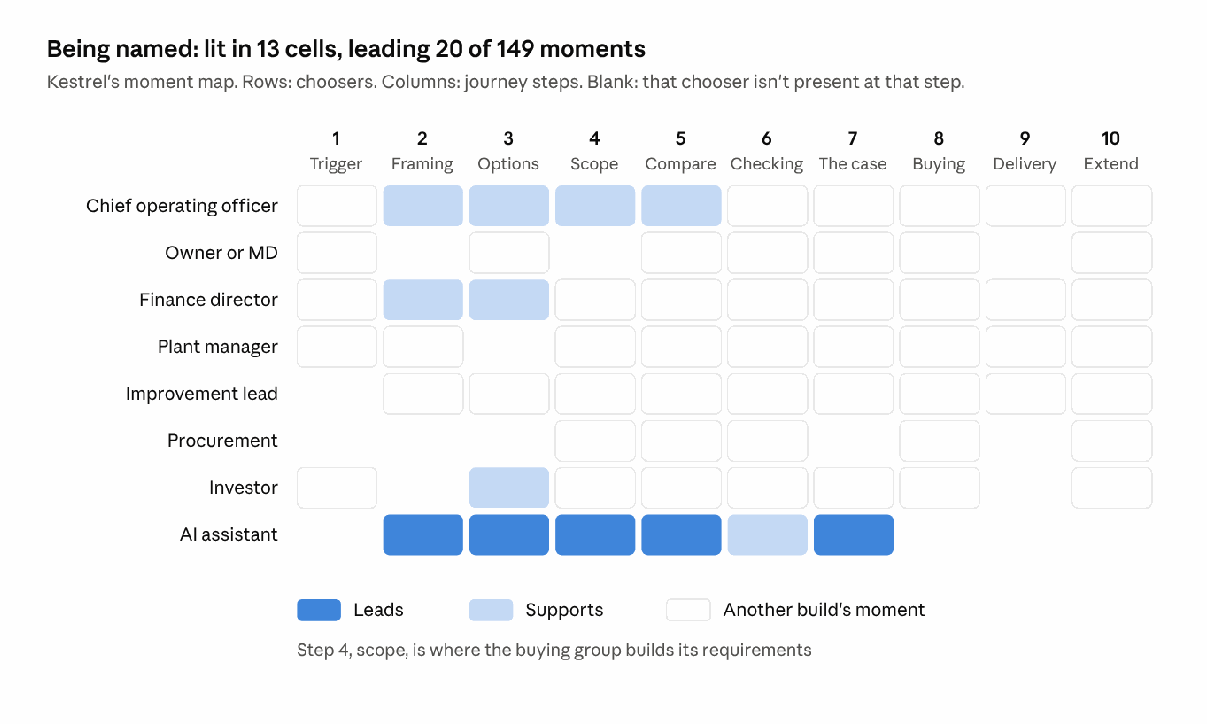
This build leads every question Kestrel's buyers put to an assistant before the pitch: what's wrong, what the options are, what a good review should cover, who does this, and what it costs. It supports the COO's and finance director's early searches, the investor's search for firms, and the reputation check every buyer runs before signing: "Is Kestrel Advisory any good?"
Measuring how assistants see you is diagnosis: it belongs to step five, the Selectability Score. Earning a place in their answers is this build.
Kestrel in 60 seconds. Kestrel Advisory is the invented firm used in every playbook: a 60-person operations consultancy that helps mid-sized manufacturers find waste and lift output. Its main offer is a fixed-price, six-week operations review. Its strategy is in Part one, and its full moment map, every chooser's question at every step, in Where you stand, part one.
- Who chooses: usually a committee. The COO starts it, the finance director approves the spend, the plant manager lives with it and procurement runs the paperwork. The owner, the in-house improvement lead, an investor and AI assistants all have a say.
- The reason to be chosen: "We find the savings on the floor in six weeks, at a fixed price, and the review pays for itself or you don't proceed." (Invented. A real firm would need proof for every part of that sentence.)
- The alternatives: a large consulting firm, a specialist lean consultant, the in-house improvement team, buying new equipment, or doing nothing.
Its slice of the Score
This build owns the gate at the 61 moments asked of machines: Known (do assistants recognise Kestrel, and tie it to this moment?) and Found (is it named when buyers ask without naming it?). It shares Believed and Preferred with PR and reviews, wherever Kestrel is named. The numbers come from the Selectability Score; the scan below is the same one, read for this build.
| Kestrel today, at the 61 moments | Known | Found | Moment score |
|---|---|---|---|
| Average | 12 | 0.5 | 0.2 |
| Points the Score loses here | 11 | 31 | 42 of the 82 lost |
Half of everything Kestrel loses, it loses at these 61 moments, and nearly all of it at Found. No other build has as much of the Score riding on it. That's also why it's slow: Found moves only when the sources assistants read have changed, and they read on their own schedule. Expect the first movement two or three monthly scans after the work starts, not the week after.
Step 1: the shape, the sources the category is judged on
For a website, the shape is the page types buyers expect. For search and AI answers, it's the sources assistants and search engines draw on when someone asks about the category. Every category has its own mix, and it's knowable: run the questions, count what gets cited. For B2B professional services sold to manufacturers, the mix usually looks like this:
| Source type | What assistants and search use it for | In Kestrel's category |
|---|---|---|
| Firms' own sites | What a firm does, who for, at what price, with what proof | Problem, sector, price and results pages; structured data; a plain-text copy of each page |
| Trade press and research | Framing a problem, and which firms are worth knowing | Manufacturing magazines, industry reports, benchmark studies |
| Comparison and "best of" articles | Shortlists | Directory round-ups, trade press lists, consultants' own comparison pages |
| Directories and member lists | Who exists, what size, which sector | Industry association member lists, consultant directories |
| Reviews and ratings | Whether a firm is any good | Review platforms for B2B services, map listings |
| Community discussion | What practitioners really think | Forums, practitioner groups, discussion threads |
| Government and supplier panels | Who is approved, and what support exists | Productivity programmes, approved supplier lists |
| Video and podcasts | How the work looks in practice | Plant walk-throughs, manufacturing podcasts |
| Professional profiles | Who the people are, and their experience | Company and personal profiles |
The entity runs through the shape. Before anything is published, write down the facts every source must state the same way:
- The name, with what makes it unique: "Kestrel Advisory, the operations consultancy for mid-sized manufacturers". Never plain "Kestrel", which is shared by other firms.
- Who it's for: manufacturers with 100 to 500 staff, in food and drink, packaging, metal and engineering, and plastics and rubber.
- The offer: a fixed-price, six-week operations review, on site.
- The way out: if the review doesn't find more than it costs, the client doesn't go ahead.
- The proof pattern: a named plant, a before-and-after number, the plant manager's words.
Assistants repeat what most sources agree on. A fact stated five different ways in five places gets dropped, or mixed up with another firm's.
Step 2: coverage, the question set
The coverage unit for this build is each moment's questions, and who gets named today. Start from the footprint: every lit cell, split by problem and sector where the question changes. That's 61 moments: 20 this build leads and 41 it supports.
Lead moments get three versions of the question, because buyers ask the same thing three ways:
1. As typed into search: "operations review cost"
2. As asked of an assistant, in full: "What does an operations review cost for a 200-
- person food plant, and what does it usually return?"
3. With a follow-up or a constraint: "Is fixed price better than day rates for that?"
Supporting moments get one version each: the lead build carries the rest.
| Cell | This build | Moments | Versions each | Questions |
|---|---|---|---|---|
| Assistant · framing: "Why is my factory's output flat?" | Leads | 7, one per problem | 3 | 21 |
| Assistant · options: "How do I improve productivity in a factory?" | Leads | 7, one per problem | 3 | 21 |
| Assistant · scope: "What should I look for in an operations consultant?" | Leads | 1 | 3 | 3 |
| Assistant · comparing: "Best operations consultants for mid-sized manufacturers?" | Leads | 4, one per sector | 3 | 12 |
| Assistant · building the case: "What does an operations review cost, and what does it return?" | Leads | 1 | 3 | 3 |
| COO · framing: "Is it people, process, equipment or planning?" | Supports content | 7 | 1 | 7 |
| COO · options: "Fix it ourselves, buy equipment or bring someone in?" | Supports the website | 7 | 1 | 7 |
| COO · scope: "What should the review cover, and what does a good one look like?" | Supports the website | 7 | 1 | 7 |
| COO · comparing: "Who does this for plants our size, in our sector?" | Supports the website | 4 | 1 | 4 |
| Finance director · framing: "Where's the money going?" | Supports content | 7 | 1 | 7 |
| Finance director · options: "What does each option cost and return?" | Supports the website | 7 | 1 | 7 |
| Investor · options: "Which firms deliver operations value quickly?" | Supports PR | 1 | 1 | 1 |
| Assistant · checking: "Is Kestrel Advisory any good?" | Supports PR | 1 | 1 | 1 |
101 questions. Each one runs on five assistants and one search engine, three times each, because answers vary. That's 1,818 answers in a single scan, every one recording whether Kestrel is named, who's named instead, what's said about each, and which sources were cited. And because answers change as sources change, the scan runs again every month.
Three rules for writing the questions:
- Use the buyer's words, not yours. They come from the cell: the top question, the pain, the objection. Nobody asks for "operational excellence partners".
- Leave your name out, except in reputation questions. A question that names Kestrel tells you nothing about whether a buyer would find it.
- Keep the set stable. Change the questions and you can't compare one month with the next. Add new ones when the grid changes; retire old ones with a note.
Step 3: who gets named today, then gaps, biases and jobs
Run the question set before changing anything. The first scan gives two things: the sources the category is actually judged on, and where Kestrel stands in each moment. All the results below are invented for the example.
The sources. Count every citation across the 1,818 answers and group them by source type. A source type cited in at least one in ten citations is canon for this category: it's where assistants look, so it's where Kestrel has to be.
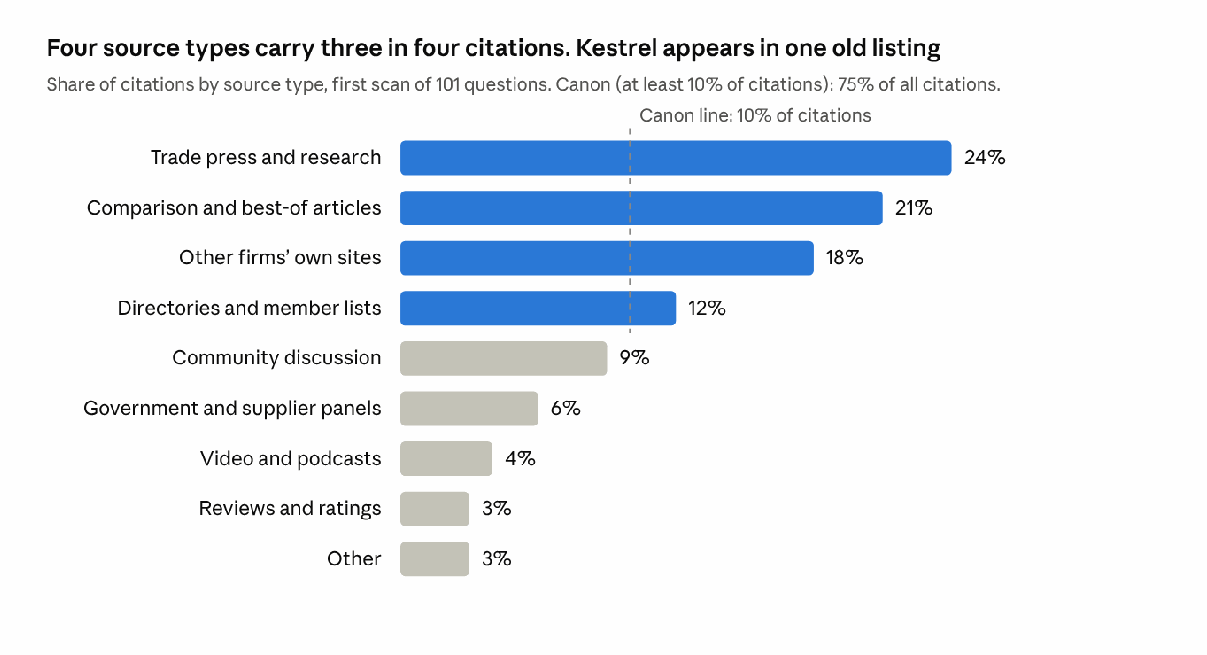
Where Kestrel stands. A question counts as "named" if Kestrel appears in at least one engine's answer, in any of the three runs. Kestrel is named in 4 of the 101 questions, and in one of those the facts are wrong.
| Questions | Count | Kestrel named | Who's named instead, and what's cited | The stage that fails |
|---|---|---|---|---|
| Assistant · framing, seven problems | 21 | 0 | No firms; trade press, a large firm's articles, a government productivity guide | Found |
| Assistant · options, seven problems | 21 | 0 | A large firm and a lean specialist, from their own articles | Found |
| Assistant · scope: what to look for | 3 | 0 | A large firm's hiring checklist, which favours large firms | Answered |
| Assistant · comparing, four sectors | 12 | 1 | Two large firms, a lean specialist and an engineering firm; Kestrel once, in packaging, from an old directory listing | Found, then Preferred |
| Assistant · cost and return | 3 | 0 | "It varies widely"; one large firm's return claim, unsourced | Answered |
| COO and finance director · framing, options and scope | 35 | 2 | Two old Kestrel blog posts on page one for two problems; otherwise press and large firms | Found |
| COO · comparing, four sectors | 4 | 0 | The same firms as the assistant's shortlist | Found, then Preferred |
| Investor · options | 1 | 0 | Large firms with private equity practices | Found |
| "Is Kestrel Advisory any good?" | 1 | 1 | Named, but mixed up with a mining-services firm of a similar name; no reviews cited | Believed |
Each gap becomes a job: a stage, a moment and a bias.
| Moment | Stage | Bias | The job |
|---|---|---|---|
| Assistant · framing: "Why is my output flat?" | Found | Good enough beats best | Publish answer-first passages on each problem page, with sourced figures, so they can be quoted |
| Assistant · framing | Known | Familiar feels safe | Get the benchmark report covered in the trade press assistants already cite for these problems |
| Assistant · options | Answered | A hard choice stalls | A fair comparison of the options, including buying equipment and doing it in-house, in passages an assistant can lift |
| Assistant · comparing, by sector | Found | Good enough beats best | One sentence on every sector page that states size, sector and offer; the same sentence in every directory and member list |
| Assistant · comparing | Preferred | Feeling first, reasons after | Give assistants the reason in words they can repeat: fixed price, six weeks, pays for itself or you don't proceed |
| Assistant · comparing | Found | We follow others | Be included in the comparison articles that make up a fifth of all citations, on merit, with a case per sector |
| Assistant · cost and return | Answered | Losses loom larger | Publish the price range, the typical return and the way out, side by side, with each figure sourced |
| "Is Kestrel Advisory any good?" | Believed | Familiar feels safe | Fix the mix-up: state the full name and what makes it unique everywhere, correct the confused listings, add structured data for the organisation |
| "Is Kestrel Advisory any good?" | Believed | We follow others | Reviews from client finance directors and plant managers, on the platforms assistants cite |
| Investor · options | Found | We follow others | Appear in the investor-facing press and portfolio operations articles, with portfolio cases |
| COO and finance director · search | Found | Good enough beats best | Move what the two ranking blog posts earned onto the new problem pages, so the rankings carry over |
| All moments | Found | Familiar feels safe | Keep sources current: date every figure, refresh the benchmark each year, update listings when facts change |
Every job names a moment, a stage and a bias. That's what stops this build turning into "more content".
Step 4: reconcile, the source plan and the answer plan
Put the jobs into the shape. Two plans come out of it: which sources to work on, and what answer each group of questions should give.
The source plan
The same three signals as the website set each source's priority. Canon: the source type carries at least one in ten citations. Coverage: it carries jobs from Step 3. Strategy: the positioning needs it.
| Source | Signals | Priority | The jobs it carries | What Kestrel does |
|---|---|---|---|---|
| Kestrel's own site | Canon, coverage, strategy | P1 | Answer-first passages, price and return, the sector sentence, the options comparison | Built in the Website Playbook: problem, sector, price, results and comparison pages; organisation structured data; a plain-text copy of each page |
| Trade press and research | Canon, coverage, strategy | P1 | Framing and options; being known for the problems | The annual benchmark report, offered to the titles assistants already cite; articles by Kestrel's people on each problem |
| Reviews and ratings | Coverage, strategy | P1 (strategy) | "Is Kestrel any good?"; belief at comparing | Reviews from client finance directors and plant managers, asked for after the results are in |
| Comparison and best-of articles | Canon, coverage | P2 | Being on the shortlist, by sector | A one-page fact sheet and a case per sector, sent to the editors of the lists that are cited; corrections where facts are wrong |
| Directories and member lists | Canon, coverage | P2 | The sector sentence; fixing the mix-up | The same sentence in every listing; the old listing corrected; membership of the four sector associations |
| Community discussion | Coverage | P3 | What practitioners think | Kestrel's people answer practitioner questions under their own names, saying where they work |
| Government and supplier panels | Coverage | P3 | Procurement and investor checks | Approved-supplier listings where clients ask for them |
| Video and podcasts | Coverage | P3 | How the work looks | One plant walk-through per sector; guest spots on the podcasts that are cited |
| Professional profiles | Coverage | P3 | Who will be on site | Team profiles that match "The team on your floor" |
Rejected, with reasons:
- An encyclopedia entry. A 60-person firm is unlikely to meet the notability rules, and writing your own entry breaks them. It would be removed, and the attempt would be visible.
- Paid places in best-of lists. A paid placement is an ad. It belongs in the advertising playbook, labelled as one.
- Mass-produced articles. No moment needs them. Thin pages dilute the passages that do the work, and contradict the proof pattern.
- Questions outside the grid (lean certification, factory software reviews). No chooser asks them on the way to buying a review.
The answer plan
For each group of questions, write the answer Kestrel wants an assistant to give, the passage that holds it, and the sources that must agree with it. This is this build's equivalent of a sitemap.
| Questions | The answer we want | The passage that holds it | Sources that must agree | Priority |
|---|---|---|---|---|
| Comparing, by sector (16) | Kestrel Advisory, the operations consultancy for mid-sized manufacturers, runs fixed-price, six-week reviews in plants like theirs, with a named case | The first passage of each sector page; one case per sector | Directories and member lists; comparison articles; reviews | P1 |
| Cost and return (3) | A fixed price range; the review typically finds more than it costs; if it doesn't, the client doesn't go ahead | Price and terms; results across every review | Benchmark coverage in the trade press; reviews | P1 |
| Reputation (1) | The right firm, the right facts, and what clients say | About; results; reviews | Reviews; directories; profiles | P1, because wrong facts get repeated |
| Framing, by problem (35) | Kestrel's explanation of the cause, with a benchmark figure | Problem pages; the guide | Trade press articles drawing on the benchmark | P1 for flat output and rising costs, P2 for the other five |
| Options, by problem (35) | A fair comparison, including buying equipment and doing it in-house, and when each is right | Kestrel compared; Kestrel vs new equipment | Trade press; comparison articles | P1 for new equipment, P2 for the rest |
| Investor (1) | Kestrel works with portfolio companies, starts within the first 100 days, and reports in board terms | For private equity investors | Investor-facing press | P2 |
| Scope, what to look for (10) | What a good operations review covers, how to brief one and how to compare quotes, fairly, with fixed price and a way out among the criteria | The review guide; Questions to ask; For procurement | Trade press; directories and member lists | P2 |
The coverage test: every one of the 61 moments has a target answer, a passage and at least one source. Every canon source type has a plan. And one check the website doesn't need: every source states the entity facts the same way. If one directory says "100 to 500 staff" and another says "mid-market", fix one before writing anything new.
The anatomy library
For a website, the anatomy is the page. For this build it's the passage: the few sentences an assistant lifts to answer one question. Each kind of question wants its own passage shape. These are the eight Kestrel's answer plan uses.
| Passage type | Answers | Its shape | Length | Where it lives |
|---|---|---|---|---|
| The entity line | "Who is Kestrel Advisory?" | Full name · what it is · who it's for, by size and sector · the offer | One sentence, identical everywhere | Every page footer, every listing, every profile, the fact sheet |
| The cause | "Why is my output flat?" | The answer first · the three usual causes, ranked · one sourced figure · what to check first | 80 to 120 words | Problem pages; articles in the trade press |
| The options | "How do I improve productivity?" | Each option in one line · when each is right, including the ones that aren't you · the order to try them | 100 to 150 words | Comparison pages; the guide |
| The shortlist entry | "Best consultants for food manufacturers?" | Entity line · what makes it different, in the reason's words · one case from this sector | 40 to 60 words | Sector pages; comparison articles; directories |
| The price and return | "What does a review cost and return?" | The range · what sets it · the typical return, sourced · the way out | 50 to 80 words | Price and terms; the results page |
| The criteria | "What should I look for?" | Five criteria, fairly put · why each matters · questions to ask any firm | 100 to 150 words | "Questions to ask"; the procurement page |
| The proof | "Does it work?" | Named plant, size and sector · before and after · who confirmed it · the plant manager's words | 40 to 70 words | Case pages; reviews; the benchmark |
| The reputation | "Is Kestrel Advisory any good?" | Entity line · years and reviews completed · what clients say, with the platform · how to check | 60 to 90 words | About; review platforms; profiles |
Three rules hold for every passage:
- It stands alone. No "as mentioned above", no pronoun pointing at the previous paragraph. An assistant lifts it without its neighbours.
- Its facts match the fact sheet word for word. "100 to 500 staff", never "mid-market" in one place and "SMEs" in another.
- Every figure carries its source in the same sentence. A figure whose source is two paragraphs away gets quoted without it, or not at all.
Step 5: the answer brief, then a brief for every passage
Assistants don't quote pages. They quote passages: a few sentences that answer one question on their own. So this build briefs at two levels. The answer brief holds what no single passage can: the questions, what's said today, the answer wanted, the facts that must match, and the sources to earn. Then each passage gets its own brief, like a section on a web page.
Here's the answer brief for one group of questions:
ANSWER BRIEF Comparing, food and drink
QUESTIONS (4) "Best operations consultants for mid-sized food
manufacturers?" + two other versions; COO: "Who does this for food plants our
size?"
MOMENT Assistant and COO · comparing · food and drink · stage: Found, then
Preferred · bias: good enough beats best
TODAY Not named. Named: two large firms, a lean specialist. Cited: two
comparison articles, a trade magazine, a large firm's site
THE ANSWER WE WANT Kestrel Advisory, the operations consultancy for mid-
sized manufacturers, runs fixed-price, six-week operations reviews in food
and drink plants, working on the floor on changeovers and hygiene downtime. A
named plant, its before-and-after figure and its plant manager's words
FACTS THAT MUST MATCH Name and descriptor; 100 to 500 staff; the four
sectors; fixed price; six weeks; on site; the way out
PASSAGES Food and drink page: "Who we work with" and "What a review finds in
a food plant"; the food case page; Price and terms: "What it costs"
SOURCES TO EARN The two cited comparison articles (fact sheet + food case);
the food manufacturers' association member list; two reviews from food
clients
GUARD No claim an assistant can't check ("leading", "best"); every figure
sourced and dated; the full name every time
Then each passage gets its own brief. Two of the four:
PASSAGE Food and drink page · "Who we work with"
ANSWERS "Who does operations reviews for mid-sized food manufacturers?"
FIRST SENTENCE The answer, with the entity facts: who, for whom, what, at
what price model
THEN The two problems food plants bring most, in the plant manager's words;
one named plant
LENGTH Under 80 words, so it stands alone when lifted
ENTITIES Kestrel Advisory; operations review; food and drink manufacturing;
the named plant
GUARD Reads correctly with nothing around it; matches the directory sentence
word for word
PASSAGE Price and terms · "What it costs"
ANSWERS "What does an operations review cost, and what does it return?"
FIRST SENTENCE The fixed price range, for which plant sizes
THEN What's included; the typical return across reviews, with its source and
date; the way out, in the contract's own words
LENGTH Under 80 words
ENTITIES Kestrel Advisory; operations review; the price range; the results
page
GUARD The range matches proposals and every listing; the return figure comes
from the results page, never rounded up
The flow check is different here. A web page is read top to bottom; a passage is lifted on its own. So read each passage alone, as an assistant would quote it. If it needs the paragraph before it to make sense, rewrite it.
The finished example: one answer, written everywhere it has to be
One answer from the plan, done in full: the food and drink shortlist. The question is "best operations consultants for mid-sized food manufacturers". Today, assistants name two large firms, a lean specialist and an engineering firm, and never Kestrel. Here's every piece it takes to change that. Kestrel, its clients and its people are invented.
1. The entity line, fixed once and used everywhere:
- Kestrel Advisory is the operations consultancy for mid-sized manufacturers: plants with 100 to 500 staff in food and drink, packaging, metal and engineering, and plastics and rubber. Its fixed-price, six-week operations review finds savings on the floor, and if it doesn't find more than it costs, the client doesn't go ahead.
2. The shortlist entry, the first passage on the food and drink page:
- Operations reviews for food and drink manufacturers with 100 to 500 staff. Kestrel Advisory reviews food plants on the floor, over six weeks, at a fixed price. In 2025 it reviewed Calloway Foods, a 310-person sauce and dressings maker: scrap on the main filling line fell from 4.1% to 2.6% within three months, confirmed by Calloway's finance director. If a review doesn't find more than it costs, the client doesn't go ahead.
3. The directory listing, corrected in the four association member lists and the two consultant directories assistants cite:
- Kestrel Advisory · Operations consultancy · Manufacturers with 100 to 500 staff · Food and drink; packaging; metal and engineering; plastics and rubber · Fixed-price, six-week operations reviews · Not affiliated with Kestrel Mining Services.
4. The correction request, sent to the directory whose old entry assistants mix up with a mining-services firm:
- Our listing combines two firms. Kestrel Advisory is an operations consultancy for manufacturers; Kestrel Mining Services is unrelated. Please replace our entry with the attached text, and remove the mining sector and the old address. Our website states the same facts at kestreladvisory.example/about.
5. The fact sheet for editors, one page, sent with a sector case to the three comparison lists that make up a fifth of citations: the entity line; the offer, price range and way out; the four sectors and size band; one case per sector, each confirmed by the client; the two people editors can quote, with their plant experience; and the benchmark's headline figure, with its method.
6. The structured data on the about page, stating only what the page says:
{"@context": "https://schema.org", "@type": "ProfessionalService",
 "name": "Kestrel Advisory",
 "description": "Operations consultancy for manufacturers with 100 to 500
staff",
 "areaServed": "Australia",
 "knowsAbout": ["Food and drink manufacturing", "Packaging manufacturing",
                "Metal and engineering", "Plastics and rubber"],
 "sameAs": ["[association member page]", "[consultant directory page]",
            "[company profile]"]}
7. The answer Kestrel wants back, the test the monthly scan applies:
- "...Kestrel Advisory works with food manufacturers of 100 to 500 staff, on a fixed-price, six-week review; it reports a 37% scrap reduction at Calloway Foods..."
If the assistant names Kestrel, gives the size band, the fixed price and a food case, the answer has landed. If it names Kestrel with mining in the same sentence, step 4 hasn't. Six pieces of work, in six places, for one question in one sector. There are three more sectors, and six more groups of questions in the answer plan.
Templates
The entity fact sheet (one per firm; every source copies from it)
FULL NAME [the name, plus what makes it unique]
NOT TO BE CONFUSED WITH [firms with similar names, and how they differ]
ENTITY LINE [one sentence: what it is, who for, the offer]
WHO FOR [size band, sectors, regions, word for word]
THE OFFER [what, how long, how priced]
THE WAY OUT [the guarantee or exit, as in the contract]
PRICE [the range, and what sets it]
PROOF PATTERN [what every case states]
PEOPLE TO QUOTE [names, roles, experience]
LINKS [site, profiles, listings: every place the facts appear]
LAST CHECKED [date, and by whom]
The question set (one row per question; never edited, only retired)
| ID | Moment (chooser · step · need) | Lead or support | Version (search / assistant / follow-up) | The question, in the buyer's words | Added | Retired, and why |
|---|---|---|---|---|---|---|
The answer brief (one per group of questions)
QUESTIONS [the IDs in this group]
TODAY [who's named, what's said, what's cited]
THE ANSWER WE WANT [in one or two sentences]
FACTS THAT MUST MATCH [from the fact sheet]
PASSAGES [type from the anatomy library, and where each lives]
SOURCES TO EARN [from the source plan, with what each needs]
PRIORITY [P1-P3, and why]
DONE WHEN [what the scan must show, for how many months running]
The passage brief
PASSAGE TYPE [from the anatomy library]
THE QUESTION [answered in the first sentence]
JOB [stage · chooser and moment · bias]
FACTS [from the fact sheet, word for word]
FIGURE + SOURCE [in the same sentence]
LENGTH [from the anatomy library]
GUARD [passes only if it reads correctly on its own]
The scan log (one row per question per month)
| Month | Question ID | Engine | Runs naming Kestrel (of 3) | Facts right? | Reason given? | Named instead | Sources cited |
|---|---|---|---|---|---|---|---|
Step 6: the business check
- Revenue: the sector and cost questions sit closest to new work. If the plan spends most effort on framing questions, it's chasing attention, not choices.
- One truth: the entity facts are identical on the site, in every listing, in proposals and in the fact sheet sent to editors.
- The proof is real: the benchmark report needs enough reviews behind it, and clients' permission to use their data. Without both, it isn't published, and the trade press plan waits.
- Reviews are earned: asked for after the results are in, from clients who agree, never paid for or written for them.
- Capacity: someone owns the monthly scan, the listings and the press relationships. If nobody does, start with the four P1 jobs: the sector sentence everywhere, the price passage, the mix-up fixed, and reviews.
Step 7: the measures
Measure shares across many runs, never single answers. Report by group of questions, by engine and by month.
| Measure | What it tells you | Stage |
|---|---|---|
| Share of questions where Kestrel is named | Whether Kestrel is in the running at all | Found |
| Share of answers naming Kestrel that give its reason | Whether the reason is getting through | Preferred |
| Share of answers with Kestrel's facts right | Whether the entity is clear, or still mixed up | Believed |
| Position in shortlists | First named, or an afterthought | Preferred |
| Share of citations from sources Kestrel has worked on | Whether the source plan is working | Found |
| Buyers who say an assistant or search named Kestrel, from first-call notes | Whether being named turns into conversations | Bought |
From the first scan, Kestrel is named in 4 of 101 questions, with wrong facts in one. A plan that works shows up in that order: facts corrected first, then named in the sector questions, then the reason given back. Clicks barely appear in this list. Most of the value happens before anyone clicks.
In the campaign plan
This build rarely leads a campaign, but every campaign leaves something behind for it: a page, an article, a review, a mention in a source assistants read. The rule in the campaign plan: every campaign names the questions it should move, and the scan checks them a month or two later.
| Kestrel campaign | What it leaves for this build | Questions it should move |
|---|---|---|
| The annual benchmark | Coverage in the trade press assistants cite; a quotable summary on the site | Framing, all seven problems; cost and return |
| "Before you buy another line" | The comparison page, and the article it's based on | Options, by problem; the new-equipment comparison |
| Owners' round table | A write-up in an association newsletter; speaker profiles | The investor's and owner's options; reputation |
| A sector case each quarter | The sector page's case; the fact sheet updated for editors | Comparing, in that sector |
| Review requests after results | Reviews on the platforms assistants cite | "Is Kestrel Advisory any good?" |
A campaign that leaves nothing for an assistant to read has reached only the people who saw it that week.
Running it
Who owns it. At Kestrel, the marketing lead owns the question set, the fact sheet and the monthly scan. PR owns the press, list and review relationships. The managing partner signs the fact sheet, because every source copies it.
| When | What happens | Takes |
|---|---|---|
| Monthly | The scan: 101 questions, six engines, three runs. The scan log updated; any wrong fact flagged the same day | Half a day to read, with the scan automated |
| Monthly | Corrections: every wrong fact traced to its source, and the source asked to fix it | One to two hours |
| Quarterly | The source plan reviewed against what was cited; one sector case added; the fact sheet re-checked | A day |
| Yearly | The benchmark published; the question set reviewed against the map | Several weeks, mostly the benchmark |
| When a fact changes | Price, sectors, size band or the way out: the fact sheet first, then every place on its links list, the same week | Depends on the list; keep it short |
Correcting an assistant. You can't edit an answer. You can fix what it reads. Find the sources it cites for the wrong fact, correct those you control, ask the owners of the rest, and make sure your own pages state the right fact in the first sentence. Then wait two scans before judging.
What not to do. No paid places presented as editorial, no reviews written for clients, no thin pages written to catch questions. Assistants and search engines are built to discount them, and the first two would break the claims rule: nothing said that Credentials can't sign.
Common mistakes
| The mistake | The stage it breaks | The bias it ignores | What it would do at Kestrel | Instead |
|---|---|---|---|---|
| Chasing rankings, not being named | Found | Good enough beats best | Celebrate two blog posts on page one, while assistants name four other firms | Measure the share of answers that name you |
| Checking a handful of questions in one assistant | Found | We follow others | One good answer in packaging, read as a trend | The full question set, six engines, three runs, every month |
| Counting questions that name you | Found | Familiar feels safe | "Is Kestrel any good?" makes the firm look visible | Branded questions only for reputation, never for Found |
| Facts stated five ways in five places | Believed | Familiar feels safe | "Mid-market", "SMEs" and "100 to 500 staff": the assistant drops all three, or mixes Kestrel with a mining firm | One fact sheet; every source copies it |
| Being named without the reason | Preferred | Feeling first, reasons after | Kestrel on the shortlist as "a smaller consultancy" | Passages that carry the reason in words an assistant can repeat |
| Writing only about yourself | Answered | A hard choice stalls | No answer to "should I just buy a new line?" | Fair options passages, including when the alternative is right |
| Buying or faking the sources | Believed | We follow others | A paid list place or written-for-them reviews, found out by an editor | Earned places and real reviews, asked for after results |
| Judging it by clicks | All, unseen | Good enough beats best | "AI sends us 30 visits a month", while buyers search Kestrel by name after reading an answer | Being named, being right, and branded search and direct visits read together |
| Expecting it next week | Found | Losses loom larger | The work is dropped after one flat scan | Two or three scans before judging any change |
The bias to watch in the team: the illusion of control. You don't write the answer. You write what the answer is built from, and you earn a place in the sources that build it.
The Loop for this build
Each quarter the Loop (step 11) reads three months of scans against the answer plan, one group of questions at a time, and asks: is the answer we wanted coming back, from the sources we worked on?
| What the Loop finds | What it means | What changes |
|---|---|---|
| Named more, facts right, reason missing | The entity is clear; the passages don't carry the reason | Rewrite the shortlist entries and the price passage |
| Named more, facts wrong | A source is still contradicting the fact sheet | Trace the citations; correct the source, not just the site |
| Not named, sources unchanged | The source plan hasn't been worked, or the sources didn't take it | Check the P1 sources one by one; change approach, not effort |
| Not named, sources changed | Assistants haven't re-read yet, or the passages don't answer the question | Wait one more scan; then test the passages against the question |
| Named, but no change in branded search, direct visits or first calls | Being named isn't turning into conversations | Check Preferred and the reason; check the site's Bought |
What Kestrel's first year would look for. Corrections first: the mining mix-up gone within two or three scans of the listings being fixed. Then the sector questions, as the sector pages and directories line up: named in some food and packaging answers by mid-year. The framing and options questions last, because they depend on the benchmark being covered, and that comes once a year. If Kestrel is named in a quarter of the comparing questions by the year's end, with its reason, the build is working, even though the Score will still say "rarely selected" at those moments. Found moves first; the Score follows.
Shapes by business type
The source mix changes with the business. Run the questions and count the citations to find yours; these are the usual starting points.
| Business type | Sources that usually carry the most weight |
|---|---|
| B2B professional services | Trade press, comparison articles, directories and member lists, firms' own sites |
| B2B software | Software review platforms, comparison and alternatives pages, documentation, developer communities |
| Considered consumer (finance, health, education) | Comparison sites, review sites, regulators' and government guidance, community discussion |
| Ecommerce | Product feeds and marketplaces, reviews, retailer listings, video reviews |
| Local services | Map listings and their reviews, local directories, community groups |
| Marketplaces | Reviews on both sides, community discussion, press about trust and safety |
Feeling a bit overwhelmed?
You should be, a little. That was one firm: 61 moments, 101 questions, six engines, three runs each, 1,818 answers a month, nine source types and one set of facts that has to match everywhere. Most teams try a handful of questions in one assistant and call it done. The answers change every month, so a one-off check goes out of date fast.
RocMode does the heavy part for you:
- Your questions, built from your buyers. RocMode maps your choosers and their moments, then writes the questions they ask, in their words.
- Run across leading AI assistants. Each question runs on five assistants, three times each. It records whether you're named, who's named instead, and which sources the assistants cite.
- Scored, with the biggest lever named. Your selectability, moment by moment and stage by stage, with a range on the score, questions that name you kept out of Found, and the fix worth the most points.