





Step 5, part two
Where You Stand, Part Two: Score the Moments
What the Score is for
The map says where buyers choose. The Score says how often they choose you there, and when they don't, who they choose instead.
Part one of step five found every moment that matters: for Kestrel, 149 of them, across eight choosers and ten journey steps. Part two measures each one. It gives one number for how likely Kestrel is to be selected, and one list of what to fix first. Everything in the plans that follow reads from it: the GTM Strategy's test of which moments are still open, the website's priorities, each build's own slice of the Score, and the Loop that checks whether anything moved.
The method is the one set out in Chapter 30 of Seen Isn't Selected. This playbook runs it end to end on Kestrel, so you can see every number come from somewhere.
Three things it is not:
- Not a count of sales. It's an index of your odds at the moments that matter. Nothing yet ties it to share or revenue; that test is under way, and every version of the method is published.
- Not a visibility number. Being named is the gate, not the score. A brand that's named everywhere and recommended nowhere scores low.
- Not a report card for the marketing team. It belongs to whoever owns the choice: the person who decides which fix goes first, across marketing and sales.
What it reads from the chain
The Score invents nothing. Every input was decided earlier, and it reads each one by name.
| Input | From | What the Score does with it |
|---|---|---|
| The moments | Step 5, part one: Map the moments | Scores every one of the 149, and only those. A moment that isn't on the map is left out, never counted as zero |
| The questions | The map: each cell's question, in the buyer's words | Asks them, in several phrasings, wherever that chooser asks |
| The buying modes | The map: planned committee, owner-led, urgent | Sets the quality weights for each moment |
| The claims | Step 2: Credentials, signed claims only | Checks every answer that names Kestrel against them: right, wrong or missing |
| The reason | Step 3: Brand Strategy, the reason to be chosen | Checks whether Kestrel is recommended for its own reason, or someone else's |
| The rivals | Step 3: the alternatives, and who buyers name | Records who is named instead, moment by moment |
| The facts | Step 1: Get the facts, the source store | Checks what assistants say about Kestrel against what's true |
Two rules follow. If an input changes, the Score is run again, because a new claim or a new moment changes what is being measured. And a change of method resets the baseline: when a question, a weight or the formula changes, the new number is a new series, never reported as progress.
The instrument: hear every moment where it happens
A moment is heard where the buyer actually asks. For Kestrel, that's three places, and each needs its own instrument.
| Where the moment happens | Kestrel's moments | How it's heard | What one reading is |
|---|---|---|---|
| Asked of machines. The chooser types the question into an assistant or a search box | 61 | The 101 questions from those cells, on five assistants and one search engine, three runs each | 1,818 answers a scan. The same scan feeds Being named; it's run once, read twice |
| Asked of people and places. A peer, a forum, an association, an adviser's list, a tender brief | 38 | Each moment's question in three phrasings on page one of search, plus a sample of the places that chooser asks: 40 threads, directories and adviser lists | 114 searches and 40 places a quarter |
| Inside a deal. The buyer is already talking to Kestrel: comparing, checking, building the case, buying, working together, renewing | 50 | The deal record and the assets each person was given | The last twelve months: 31 fit calls, 19 proposals, 9 wins; 7 finished engagements, 5 extended |
In every answer, five things are recorded: whether Kestrel is named, and where in the answer; who is named instead; what is said about each, checked against the signed claims; the reason given for the recommendation, if any; and the sources cited. A single answer means little, because assistants answer differently each time. Shares across many answers are what count.
Two more readings set the gate's first half, Known:
- A recognition probe. Each assistant is asked what Kestrel Advisory does, and for which problems. Is it recognised at all, and is it tied to the moments on the map?
- Branded search share. Searches for Kestrel's name against searches for the rivals buyers name instead.
One rule protects the whole instrument: questions that name Kestrel never count toward Found. Being named when someone asked for you by name proves nothing. Where a moment's questions all name Kestrel, as in an assistant's "Is Kestrel Advisory any good?", Found isn't measured, and the gate is Known alone.
Scoring a moment
Six checks
Each moment gets six checks, one per stage, each worked as a share from 0 to 100. What counts as evidence depends on where the moment happens.
| Stage | The question | Asked of machines | Asked of people and places | Inside a deal |
|---|---|---|---|---|
| Known | Does the buyer, or the machine, already know Kestrel? | The recognition probe: named, and tied to this moment | Branded search share against the rivals | Open: they're talking to Kestrel |
| Found | Is Kestrel there when they ask without naming it? | Share of unbranded answers that name Kestrel | Share of searches and places that name Kestrel | Open |
| Answered | Does what Kestrel publishes answer this buyer's question? | Share of the moment's questions the site answers | The same | Did the asset this person was given answer their question? |
| Believed | Is what's said accurate, and backed by others? | Accuracy against signed claims, outside support, consistency, in answers that name Kestrel | The same, in the places that name Kestrel | Are the claims signed, and confirmed by clients? |
| Preferred | When Kestrel appears, is it the one recommended, for its own reason? | Strength of recommendation, and whether the reason given is Kestrel's | The same | Share of deals Kestrel kept at this step |
| Bought | Does the place they land make yes easy? | Does the landing page repeat the reason, show proof and offer a next step? | The same | Did this step run without a stall: terms, start date, paperwork? |
Kept isn't a seventh check. It's the same six checks at the moments after the work starts: Kestrel's delivery and extend-and-refer moments.
The formula
Known and Found are gates. Nothing else is seen until they open. The other four are the quality of what the buyer finds.
Gate = square root of (Known x Found)
Quality = weighted average of Answered, Believed, Preferred and Bought
Moment = Gate x Quality / 100
Score = weighted average of every moment, 0 to 100
A check that wasn't measured is shown as not measured and left out of the average. It is never guessed. If Kestrel isn't named at a moment, there are no answers to judge for Believed or Preferred, so those two drop out and quality is the average of what's left.
The weights
The quality weights follow the buying mode. Kestrel's map uses three of the five:
| Mode | Kestrel's moments | Answered | Believed | Preferred | Bought |
|---|---|---|---|---|---|
| Committee (planned) | Every chooser except the owner | 25% | 30% | 30% | 15% |
| Owner-led business | The owner's 13 planned moments | 20% | 35% | 30% | 15% |
| Quick choice | The 4 urgent moments | 15% | 25% | 15% | 45% |
The moment weights favour moments nearer the decision, and the choosers who decide. Steps run from 0.6 for a trigger to 1.0 from comparing to buying; the COO, owner and finance director count 1.0, the assistant 0.9, the plant manager 0.8, the improvement lead 0.7, procurement and the investor 0.6. These are judgement, version 1.0, published and open to challenge.
Three moments, worked
| Moment | Gate | Quality | Moment score |
|---|---|---|---|
| COO · framing · flat output. Asked of machines: 2 questions, 36 answers; Kestrel named in 3, all from an old blog post still on page one of search | Known 14, Found 8: √(14 × 8) = 11 | Answered 5, Believed 35, Preferred 25, Bought 15, committee weights: 21 | 11 × 21 ÷ 100 = 2 |
| Owner · options: "Do we need outside help at all?" Asked of people: named in one association directory | Known 12, Found 10: 11 | Answered 5, Believed 40, Preferred 35, Bought 20, owner-led weights: 29 | 11 × 29 ÷ 100 = 3 |
| Finance director · building the case · flat output. Inside a deal | Open: 100 | Answered 25, Believed 30, Preferred 47 (9 of 19 proposals won), Bought 40: 35 | 100 × 35 ÷ 100 = 35 |
The multiplication is the point. The first two moments have half-decent quality, but almost nobody reaches it. The third is reached by every buyer who gets that far, and they're the only ones who do.
Kestrel's Score, worked in full
Kestrel scores 18 out of 100, with a range of 12 to 27. Rarely selected.
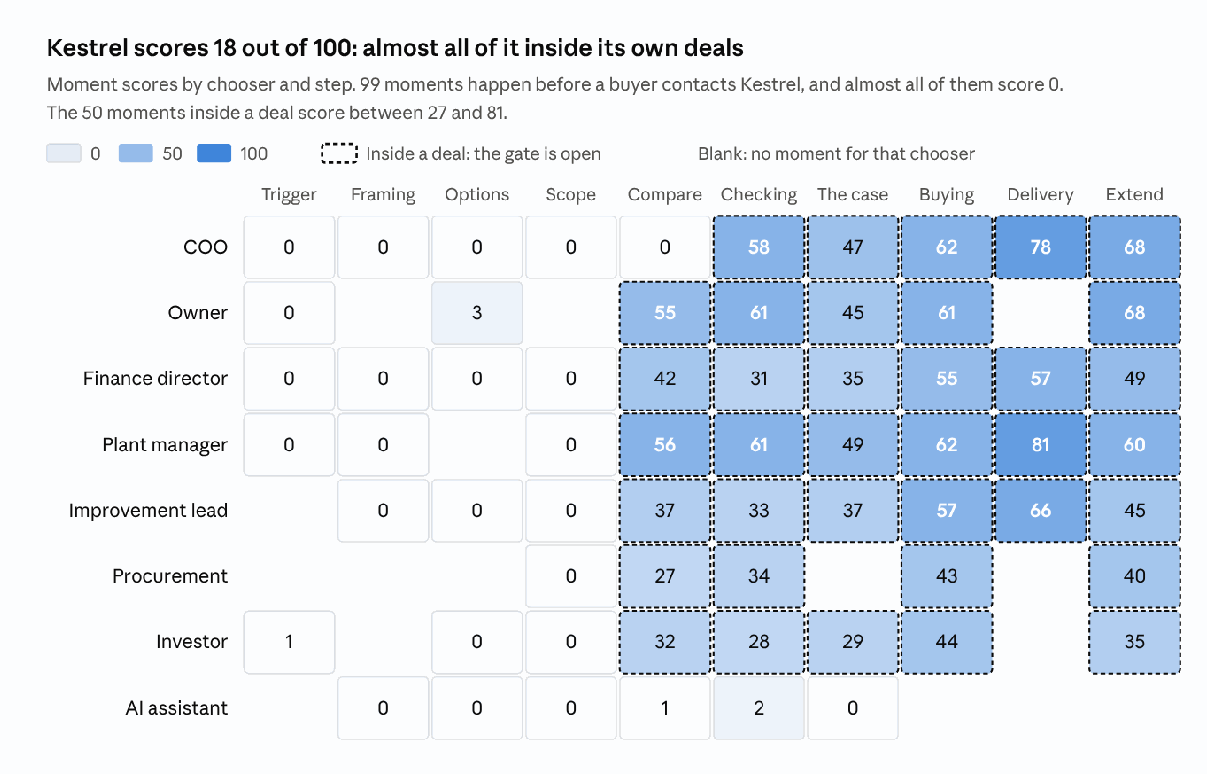
The grid splits cleanly in two. Before a buyer contacts Kestrel, it's almost absent: of the 99 moments that happen out in the market, 93 score zero. Inside a deal, it does well: 27 to 81, and best of all once the work starts. So Kestrel isn't a weak firm. It's a good firm that almost nobody finds. Of its 31 fit calls last year, 22 came by referral; the rest of the market never got as far as asking.
| Where the moment happens | Moments | Average moment score | Points of Kestrel's 18 |
|---|---|---|---|
| Asked of machines | 61 | 0.2 | 0.1 |
| Asked of people and places | 38 | 0.1 | 0.0 |
| Inside a deal | 50 | 48.5 | 18.3 |
By stage
Averages of each check, where it was measured. The number in brackets is how many moments it was measured in.
| Stage | Asked of machines | Asked of people and places | Inside a deal |
|---|---|---|---|
| Known | 12 (61) | 9 (38) | Open |
| Found | 0.5 (60) | 0.4 (38) | Open |
| Answered | 10 (61) | 6 (38) | 43 (50) |
| Believed | 31 (4) | 40 (2) | 48 (50) |
| Preferred | 22 (4) | 35 (2) | 54 (50) |
| Bought | 15 (61) | 15 (38) | 48 (50) |
Believed and Preferred are measured in only six moments outside deals, because those are the only six where anyone names Kestrel. That isn't a gap in the method. It's the finding.
Four kinds of moment
Outside its deals, every moment falls into one of four kinds, set by two measures: does the machine or the place pick Kestrel, and does Kestrel's own site answer the buyer?
| Picked | Not picked | |
|---|---|---|
| The site answers | Won: 0 | Hidden: 0 |
| The site doesn't | Borrowed: 5 | Empty: 94 |
No Hidden moments is unusual, and it matters. Most firms have answers nobody is sent to. Kestrel's old site, 14 pages about the firm, answers almost none of its buyers' questions. The five Borrowed moments rest on things Kestrel didn't plan: two old blog posts that still rank in search, an old directory listing, an association page and one adviser's list. And when an assistant is asked about Kestrel by name, it mixes it up with a mining-services firm of a similar name.
Why the range is wide
Twelve to 27 is a wide range, and it should be. Almost all of Kestrel's score rests on 19 proposals. Win two more or two fewer and the number moves by several points. The top of the range crosses into "sometimes selected". The bottom doesn't come close. Report the range every time, or a lucky quarter will be read as progress.
Where Kestrel loses buyers, and to whom
The Score is out of 100, so the gap to 100 is what's being lost. Kestrel loses 82 points. Split that loss by stage, by step and by chooser, and the biggest share is the biggest lever.
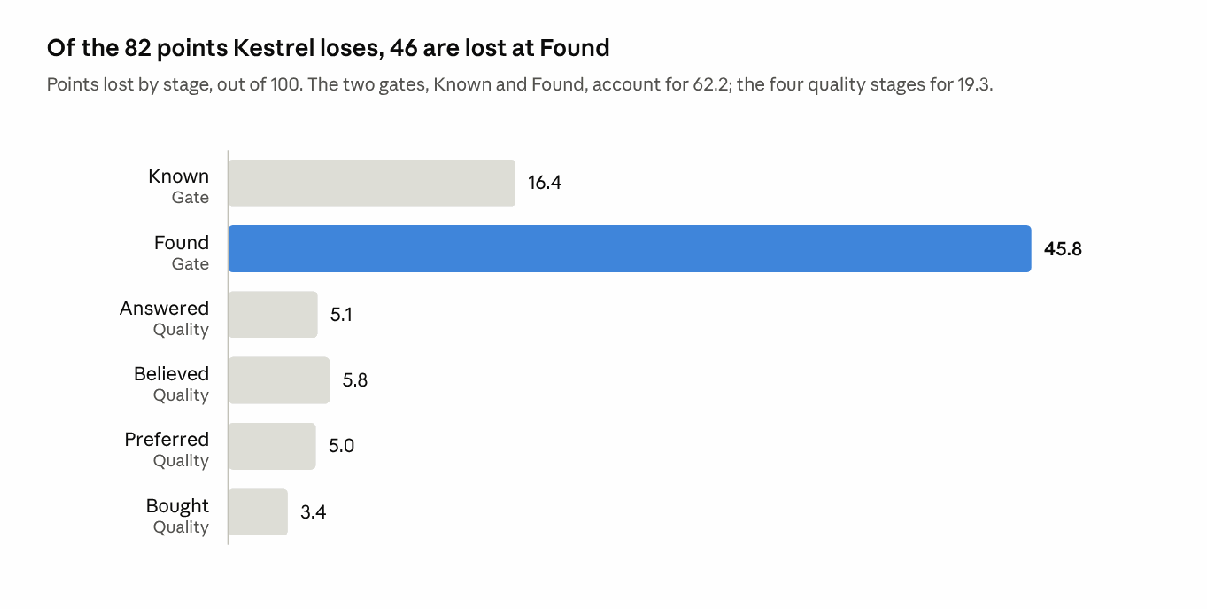
Three quarters of the loss is at the gates. Kestrel isn't losing buyers who compare it and choose someone else. It's losing buyers who never see it.
By step and by chooser
| The most points lost | Points | What's happening there |
|---|---|---|
| Options | 16 | Buyers weigh fixing it themselves, new equipment or outside help, and Kestrel isn't among the outside help anyone names |
| Trigger | 15 | Seven problems, five choosers, and Kestrel is absent from 28 of the 29 trigger moments |
| Framing | 14 | Assistants explain flat output and rising costs every day. None mention Kestrel's insight, that the capacity is usually already in the line |
| The COO | 26 | The initiator, with 41 moments; 32 of them happen before anyone contacts Kestrel |
| The finance director | 20 | Lost twice: absent while framing the cost, then thin on proof once inside the deal |
| The AI assistant | 14 | Six steps on the map, a score of 0.3. It shortlists for the whole committee and has no reason to name Kestrel |
To whom
When buyers ask without naming anyone, this is who gets named instead. Shares are of the 1,800 unbranded answers in the scan; an answer can name more than one firm.
| Named in the answer | Share of answers | Where they win |
|---|---|---|
| No firm at all: general advice | 44% | Trigger and framing. The buyer is told what to do, not who to call |
| Large firm A | 29% | Options and comparing, every sector |
| Large firm B | 22% | Options and comparing; investor questions |
| The lean specialist | 16% | Framing and the improvement lead's questions |
| The engineering firm | 8% | Options, where new equipment is the answer |
| Kestrel | 0.4% | Eight answers: six from two old blog posts that still rank in search, two from an old directory listing in packaging |
The first row is the opening. At 44% of answers nobody owns the moment yet. Large firms win comparing because they're named everywhere; nobody is winning framing, because nobody has published the explanation buyers are looking for. That's the moment Kestrel's reason was written for.
What the Score hands to the plans
One list
The loss becomes a list of fixes, ranked by how much each should lift the Score for the effort it takes. Every fix names its moments and its stages, and carries a predicted range, worked out by rerunning the Score with the fix in place.
| # | The fix | Moments and stages | Predicted lift | Effort | Shows up |
|---|---|---|---|---|---|
| 1 | Be there before they call. Problem and sector pages, the facts fixed everywhere, the explanation buyers are looking for | 97 moments outside deals, trigger to comparing; Known, Found, Answered, Bought | +4 (2 to 6) | Large | Over two or three monthly scans |
| 2 | The finance director's kit. The way out in writing; savings confirmed by clients' finance directors | The finance director's 12 moments inside deals; Answered, Believed | +1.5 (0.7 to 1.8) | Small | Next quarter's deals |
| 3 | A reference within a week. One client per sector, ready to take a call | 16 comparing and checking moments; Believed, Preferred | +0.9 (0.5 to 1.2) | Small | Next quarter's deals |
| 4 | A proposal page per person. Each chooser's own question, answered on one page | 12 building-the-case moments; Answered, Preferred | +0.9 (0.4 to 1.1) | Medium | Next quarter's deals |
| 5 | The procurement pack. Insurance, safety, terms; onto two approved-supplier lists | Procurement's 5 moments inside deals; Answered, Believed | +0.3 (0.2 to 0.4) | Small | Next tender |
Together: from 18 to about 26, with a range of 22 to 28. That's still "sometimes selected" at best, after a year's work. Say so plainly to whoever owns the choice. A firm that's absent from 94 moments doesn't fix that in a quarter, and a list that promises otherwise is selling something.
The order isn't the order of the list. Fixes 2 to 5 are small and show up within a quarter, so they go first, alongside the start of fix 1, which is slow and worth the most. That's exactly the year-one order in the Plans.
The open test
The GTM Strategy sorts moments with three tests: worth winning, a true reason there, and still open. The Score answers the third. A moment is open when nobody owns it: no firm is named in most answers, or the firms named are named without a reason. For Kestrel, trigger and framing are wide open: 44% of answers name no one. Comparing isn't: the two large firms own it. So Kestrel wins first where the field is empty and its reason is strongest, and comes to comparing with references in hand.
Each build's slice
Every build reads its own part of the Score, and its own audit starts there:
- Website: Answered and Bought, in every moment. For Kestrel, 10 and 15 outside deals.
- Being named: Known and Found, at the 61 moments asked of machines. Found is 1.
- Content and social: Found and Answered at trigger and framing.
- PR and reviews: Believed, wherever Kestrel is named, and the references inside deals.
- The pitch, events and outbound: the quality of the 50 deal moments, and Found for the owners.
- Email, automation and customers: the delivery and extend moments, which are Kept.
Predicted, then measured
When a fix ships, the next scan records what moved, beside what was predicted. Predicted against measured is how the list earns trust, and how the weights get corrected. A fix that ships and moves nothing is a finding too.
Running it
The cadence
| Reading | How often | Why |
|---|---|---|
| Asked of machines: the 101 questions, six engines, three runs | Monthly | Answers move as sources change. The same scan feeds Being named |
| Asked of people and places: searches and the 40 places | Quarterly | These move slowly; more often is noise |
| Inside a deal: the deal record and the assets | Quarterly | Kestrel closes too few deals for a monthly number to mean anything |
| The full Score, the range and the list | Quarterly | The number the owner of the choice reports |
| A rescan out of turn | When an input changes | A new claim, a new moment or a new rival changes what's being measured |
Who owns it
One person owns the Score and the list, across marketing and sales, with the standing to say no to work that moves no moment. At Kestrel, that's the managing partner. They don't run the builds. They decide which fix goes first, and which team does it.
Reading AI's influence
Most buyers who act on an assistant's answer don't click through. They search Kestrel's name, or type the address. So each quarter, read three numbers together: the share of answers that name Kestrel at its moments, searches for its name, and direct visits. If the first rises and the other two follow a month or two later, that's the assistants at work. It isn't proof, so note what else changed that quarter.
The Loop
Step eleven, the Loop, starts here. Each quarter it sets the new Score beside the old one, the measured lift beside the predicted one, and asks what changed, and what the plans should change. A change of method, a new weight or a new question set starts a new series. It is never reported as progress.
Testing the weights
The weights are version 1.0: judgement, published and open to challenge. The test is whether brands that score higher hold more share, and whether a rising score comes before rising share, not after. Kestrel can contribute one line to that test: its Score each quarter beside its new clients and fees. If the two don't move together over a year or two, the weights are wrong, and they change, with a new version number.
Common mistakes
| The mistake | What it does to Kestrel's number | Instead |
|---|---|---|
| Scoring only what machines can hear | 0.2 out of 100, and no sign that Kestrel wins half its proposals | Hear every moment where it happens: machines, people and places, deals |
| Scoring only the deals | A 47% win rate, and a firm that looks healthy while 93 moments score zero | The same: the deal record is one instrument of three |
| Counting questions that name you | "Is Kestrel Advisory any good?" names Kestrel every time, and would make Found look alive | Branded questions never count toward Found |
| Reading single answers | One lucky answer in packaging reads as a breakthrough | Shares across many runs, with a range on every number |
| Guessing what wasn't measured | Believed and Preferred are measured in only six moments outside deals. Filling the rest with an average would invent a firm that's trusted where nobody has heard of it | Show it as not measured, and leave it out |
| Counting activity | Publishing 20 pages would lift the number before a single buyer saw them | Only measured outcomes move the Score |
| Reporting a new method as progress | Adding questions or changing a weight can move the number by several points overnight | A new method starts a new series |
| Mistaking named for chosen | Large firm A is named in 29% of answers. Being named without a reason still loses the buyer who asks why | Preferred checks whether the reason given is yours |
| Giving it to marketing alone | Nearly all of Kestrel's 18 points come from the pitch and delivery, which marketing doesn't run | One owner of the choice, across marketing and sales |
And the bias to watch in yourself: the anchoring of the first number. Kestrel's 18 will feel like a verdict on the firm. It isn't. It's a measure of how often buyers get the chance to choose a firm that, once they do, they usually like.
Feeling a bit overwhelmed?
You should be, a little. One firm: 149 moments heard in three places, 101 questions on six engines three times a month, 114 searches and 40 places a quarter, 31 deals read moment by moment, six checks per moment, three sets of weights, a range on every number, and a ranked list rerun after every fix. Most firms check a handful of questions in one assistant, call the result their AI visibility, and never connect it to the deals they win.
RocMode does the heavy part for you:
- Your questions, from your moments. It writes the buyer questions for every chooser at every step, from your personas, their pains, gains and jobs, and the rivals you name.
- Asked across leading AI assistants. Each question runs on five assistants, three times each. It records whether you're named, who's named instead, and which sources are cited.
- Scored by stage, moment by moment. Found, Answered, Believed, Preferred and Bought for every moment, with a range on the score and small samples held in check. Questions that name you never count toward Found.
- The kinds of moment, and the biggest lever. Each moment sorted into won, hidden, borrowed or empty, and the fix worth the most points, with the points it should add.